Showing posts with label morality. Show all posts

Friday, July 2, 2021

A Tribute Vice Pays to Itself, or, The Joy of Getting Gelded

"Satan Cast Down From Heaven"
by Gustav Dore, 1866
      A vivid picture of sin has been given to us by St. Augustine: homo incurvatus in se, "man turned in upon himself."  The image that conjures up in my mind is rather like a dog chasing his tail . . . or myself, in some of my less glorious moments.  The point is, we direct ourselves inward, away from God, away from other people, hoping to find within ourselves what can only come from beyond.  The world in which we are living today is becoming more and more a world not so much turned in upon itself, because that would imply that we're doing it together, but a world in which each and every one of us is turned in upon ourselves, eight billion dogs simultaneously chasing their own tails.

    Such intense self-absorption is bad for us, of course, because we were made for love by the God Who is Love (1 John 4:8), and love is willing the good of another. And therein lies a problem, because one effect of sin turning us inside out is that it turns love inside out as well, so that we find ourselves actually willing evil for others.

     A few years back I ran across a story that perfectly captures the essence of a world full of people curved in upon themselves.  Please click below to find my exploration of the wonderful world of Vasectomy Showers:

[click HERE to continue reading this post on Spes in Domino]


Friday, June 4, 2021

A Martyr for Marriage

 "'For this reason a man shall leave his father and mother and be joined to his wife, and the two shall become one.'  So they are no longer two but one.  What therefore God has joined together, let not man put asunder."  (Mark 10:7-9)


"Marriage of Mary and Joseph in the Temple"
by Luca Giordano, before 1690
When I observed in my recent post "Sins of the Fathers . . .and of Kings" that "one of the greatest  contributors to poverty and other debilitating social ills today is the break-down of sexual morality", one reader commented: "It is enough to watch the news or TV for two minutes to realize that our miseries are not due to lack of dollars but to lack of morals." The connection between our sexual conduct and our societal health is impossible to miss, at least for those who aren't heavily invested in the so-called "sexual revolution". It is clear that the societal endorsement of sexual license directly undermines the institution of marriage, and the breakdown of marriage in turn has a profoundly negative impact on children most immediately, and from there on everything and everyone else.

     This last point is backed up by an enormous body of research accumulated over decades.  I'm not going to delve into that mountain of data here, except to illustrate with a small sample from a 2014 article by posted on the United States National Institute of Health website . . .


[click HERE to continue reading this post on Spes in Domino]

Thursday, March 4, 2021

From Spes in Domino: Don't Be So Judgmental!


My, how times have changed.  We used to have the Seven Deadly Sins and the Sins That Cry Out to Heaven For Vengeance. Most of these don't seem of much concern to most people any more, even in many institutions that claim to be Catholic; some are even treated almost as virtues. In their place is a larger and ever enlarging Index of Forbiddden -isms: transphobism, climate denialism, islamophobism, etc., with the Granddaddy of All, the Wickedest Capital Sin, being Judgmentalism  (unless you're judging someone you're accusing of judgmentalism . . . or one of the other isms . . . in which case it is positively a virtue) . . .

[click HERE to continue reading this post on Spes in Domino]


Thursday, May 5, 2016

Our Eternal Destiny: Armed Robbery, or A Warm Place By The Fire?

Today is Ascension Thursday; click here for my Ascension Thursday post on the blog Nisi Dominus. The throwback below, which first appeared on Nisi Dominus April 19th 2015, examines the (apparently) vexing question as to how Eternal Salvation differs from a mugging.. 

  Analogical thinking, it would appear, is a dying art.  I recently heard Catholic apologist and scholar Peter Kreeft on Catholic radio, and he was pointing out that brains which spend a lot of time interacting with video games and various other electronic devices simply don’t develop in the same way as those formed by extensive reading.  Among the those things that are undernourished are linear and analogical thinking.  Professor Kreeft has found that this makes it difficult to teach a subject like Theology that requires dealing with a lot of difficult and abstract ideas.


Is this your image of God?
     Over my own nearly 30 years of teaching high school students I’ve observed the same trend.  Fortunately, we still have a long way to go: while many people, especially young people, may not be as quick to grasp them as they might have been several decades ago, analogies are still the most effective way to communicate many ideas.  They have always been a preferred way of explaining Christian Doctrine: think of the parables of Jesus, or St. Paul's comparison in 1st Corinthians of the Church to a body, with all the members working together at their own assigned tasks; not only that, but one of the four traditional Levels of Meaning in scripture, the Allegorical, relies very heavily on analogical thinking.  Analogy is often the only reliable way for us who are composed of both spirit and matter to understand spiritual realities.
     Not surprisingly, analogies are also an essential tool in any dialogue with atheists and agnostics.  I recently became aware of the following analogy, which is appears to be in vogue in atheist circles: God, as we Christians envision Him, is like an armed robber with a gun to our heads, and he is offering a choice between giving him all our money (i.e., living according to the Gospel and spending eternity in Heaven), or having our brains blown out (which is spending eternity in Hell).
     Now, clearly, there are some very obvious problems with this analogy.  The vast majority of people, even many non-Christians, will have a hard time seeing going to Heaven as equivalent to getting mugged, even if we accept the premise that living a Christian life “robs” us of pleasures we might otherwise enjoy: Heaven promises something infinitely better than anything available here, whereas an armed robber does not even pretend to make our life better than it was before we met him.  And of course there is quite a lot of secular, sociological evidence that following God’s law actually makes us happier in the here-and-now.  Also, the robber analogy depicts Hell as something that God imposes on us, in which we take no initiative at all, when in fact the Catholic conception of Hell is that it is something that we choose for ourselves, contrary to God’s wish, by our rejection of his freely offered love.


Wouldn't you rather be inside?
     I propose a better analogy to communicate the eternal choice which God presents to us.  Imagine that we are standing outdoors on a cold, rainy night.  Somebody opens a door and invites us to come inside with them, where it is warm and dry (although, of course, we need to take off our wet muddy boots and our wet, dripping coats).  That’s God’s offer of eternal salvation.  We can say yes, although we are equally free to say no.  In fact, we can say “No, you can’t tell me what to do! Besides, can you prove it’s really warm and dry in there before I go in?”  and remain out in cold, wet darkness.  That’s Hell, the product of nothing but our own pride and stubbornness.


     The second analogy presents a much more accurate image of the Catholic view of our eternal destiny.  Not only that, when juxtaposed to the “armed robber” scenario, it also casts light behind it, as it were, giving observers a vivid illustration of the different worldviews that have generated each analogy: the atheist worldview which is concerned with power, force, and will, and in which one party must be the loser, and the Christian perspective, which envisions a reality in which love can triumph, and everyone can win.  Which is likely to appeal to more people in the end?

Thursday, April 28, 2016

Is The Catholic Church A Political Animal?

   Right now we are in the midst of an unusually rambunctious presidential election here in the United States. It seems a good time to revisit this Throwback to April 15th 2015 (first published on the blog Nisi Dominus), which looks at the difference between secular politics and "politics" within the Church.

   You’re going to find politics wherever people gather, or so someone once told me when I had objected to using the secular political terms “liberal” and “conservative” to describe different factions within the Catholic Church.  And he was right, if by “politics” we mean the small-p wrangling that unavoidably accompanies any human enterprise requiring two or more people.  But that is a very different thing from Politics, of the partisan variety.  The Church is not a political party, and does not work like a political party.  Nor should it.

Synod on the Family October 2015 (photo: Vatican Radio News)

     That may seem an obvious point to you and to me, but it’s not at all obvious to everybody.  It’s a distinction lost on a large number of people outside of the Church for instance, for many of whom politics has taken the place of religion, and so has become the lens through which they interpret everything. Many such people have come to dominate the secular media in the developed world, with the result that the mass media projects the secular political model onto the Church, with bad guys called conservatives working to thwart the good guys, the liberals (sometimes referred to as progressives), who are fighting to bring about a kinder, better Catholic Church more in step with The Times.  This is the only model of the inner-workings of the Church most people see, including most ordinary Catholics, unless they intentionally seek out Catholic publications which reject this distorted view (sadly, many self-identified Catholic outlets do not).
     That is not to say that there isn’t a wide range of legitimate differences of opinion within the Church; there most certainly is.  Unlike a political party, however, where major policy planks can change overnight with a vote of the membership (and why not? They’re only opinions), there are many things in the Church which are grounded in Divine Revelation, and are therefore not up for negotiation.  This vital distinction was expressed very clearly by then prefect of the Congregation for the Doctrine of the Faith, Cardinal Joseph Ratzinger (now Pope Emeritus Benedict XVI) in 2004.  Senator John Kerry, the nominee of the Democratic Party for President of the United States, was widely criticized for receiving communion and touting his Catholic bona fides despite his open advocacy for legal abortion and other positions contrary to Catholic moral teaching.  Accordingly, Cardinal Ratzinger wrote a letter (later published by the Holy See under the title “Worthiness to Receive Holy Communion: General Principles”) to Kerry’s ordinary, then Archbishop of Washington, D.C. Theodore McCarrick,  which gives an excellent example of how the Church is different from a political party.  For instance, Cardinal Ratzinger writes:

Not all moral issues have the same moral weight as abortion and euthanasia.  For example, if a Catholic were to be at odds with the Holy Father on the application of capital punishment or on the decision to wage war, he would not for that reason be considered unworthy to present himself to receive Holy Communion.  While the Church exhorts civil authorities to seek peace, not war, and to exercise discretion and mercy in imposing punishment on criminals, it may still be permissible to take up arms to repel an aggressor or to have recourse to capital punishment.  There may be a legitimate diversity of opinion even among Catholics about waging war and applying the death penalty, but not however with regard to abortion and euthanasia.

Joseph Cardinal Ratzinger (now Pope Emeritus Benedict XVI)
     This crucial difference can be obscured by applying secular political terms to church “politics”.  Political parties often change even basic positions, and this is sometimes a good thing: consider that, when I was a child, many prominent leaders in the Democratic Party in the United States were unapologetic White Supremacists and segregationists. Such a position would be unthinkable today, and yet nobody doubts that the Democratic Party is still the Democratic Party.  Using the political analogy can create the impression that proposed changes in the Church are benign or even desirable changes of the same sort.The difference between abortion and euthanasia on the one hand and war and capital punishment on the other is that the Church has always taught that the first two are intrinsically evil, and so never permissible; this teaching is part of the deposit of faith and cannot change, and to publicly oppose it is to separate oneself from the Church (hence the unworthiness to receive communion).  In the case of war and capital punishment, the Church has taught that, in some instances, they may be morally licit, a teaching that likewise cannot change.  While there are certain moral principles that bind a Catholic here (e.g., the Just War Doctrine), the actual application of these principles belongs to the prudential judgment of individual Catholic decision makers.  It is in matters of prudential judgment that legitimate differences of opinion may arise.

     Many so-called liberals in the Church today, however, are not advocating simply the more “liberal” application of unchanging principles in prudential situations, but are pushing for changing more foundational things like the teaching on marriage, the meaning of priesthood, sexual morality, etc.  The Catholic Church, however, can’t change its teachings and still remain the Catholic Church. One can usually make a case for being either a conservative or a liberal in political matters, but when it comes to Church Doctrine, we can only be Catholic . . . or Not. 

Saturday, January 16, 2016

St. Vitalis, Love & Human Traffficking


When a man dies, his life is revealed.
Call no man happy before his death,
for by how he ends a man is known.  (Sirach 11:27-28)


Back when I was new to the world of bloggery I published a post on St. Julia of Corsica which I called "St. Julia of Corsica - A Saint For Our Times." And, of course, she was a timely Saint. Interestingly, every time I write about another Saint, I find myself wanting to title the post the same way: "St. [Fill In The Blank], A Saint For Our Time", or " . . . A Saint For Today". It stands to reason, because sanctity, a reflection of the Eternal God, has a universal quality about it; every Saint has something that every one of us hoping to rest their heart in the Lord wants to find. At the same time, every Saint is a distinct individual, and sometimes by identifying with some of the unique aspects of a particular Saint's life, their sanctity seems a little less remote, and therefore a little more attainable, for ourselves. For just that reason we have Patron Saints and devotions to particular Saints.
It is also true that the unique stories of particular Saints illuminate specific problems or issues that are still with us today (which is another reason why we have Patron Saints). For instance, earlier this week (January 11th; the scripture quote above is from the same day's Office of Readings) we commemorated St. Vitalis of Gaza, who is venerated both in the Orthodox Churches and in the Catholic Church as the Patron Saint of both day laborers and "ladies of the night" (that is, handy-men and prostitutes: the reasons for both will be made clear below).  His hagiography [Here and Here] tells us that, around 625 A.D.,  when he was already advanced in years, he came to Alexandria in order to minister to the prostitutes.  His method, as described in the brief biography on Catholic.org, was as follows:


[A]fter obtaining the name and address of every prostitute in the city, he hired himself out as a day laborer, and took his wage to one of these women at the end of the day. He then would teach her about her dignity and value as a woman and that she did not deserve to be used by men as an object of their lust.


He followed the same routine every day, and he succeeded in rescuing a large number of women in this way.  Many fellow Christians misunderstood his motives, however, as he insisted that the women he helped not tell anybody about his role in their conversion, or the real reason for his nocturnal visits (presumably because these women - and their handlers - only let him in because they believed the he was a paying “customer": if they knew what he really wanted, they would have barred the door . . . or worse).  One righteously indignant young Christian, assuming the worst about Vitalis, struck him a blow to the head that resulted in his death.  Only then, freed from their promises of silence, were the women he had helped to save able to clear his name by their testimony.  
   There are a number of compelling angles to the story of St. Vitalis.  One is that yet again we have confirmation that “there is nothing new under the Sun” (Ecclesiastes 1:9).  The scourge of prostitution is still very much with us and, as St. Vitalis understood fourteen centuries ago, it is a vicious form of exploitation that not only enslaves the body but sickens the soul.  Despite the push in some quarters today to whitewash prostitution with terms like “sex workers”, it is becoming more commonly recognized for the evil it is, and included under the broader heading of “human trafficking” (slavery, in other words).  Nonetheless, not only is prostitution still with us, but it is in fact worse, and more pervasive, than most of us realize.  I recently had the opportunity to hear a talk by Darlene Pawlik, now a pro-life and anti-trafficking activist, but formerly an exploited teen who was first “trafficked” on her 14th birthday and who remained under the control of various traffickers for the next several years . . . all right here in United States.  She was eventually saved by turning to Christ, and with the help of Christians who, like St. Vitalis, made it their mission to reach out to the victims of the “sex trade”.  There are in fact many groups today that similarly follow in the footsteps of St. Vitalis, both among Catholics and other Christians as well.

From  http://awakenreno.org/myths-and-facts-about-nevada-legal-prostitution/

    Another point that stands out in the mission of St. Vitalis is his desire to save one soul at a time, like the shepherd in Jesus’ parable (see Luke 15:4) who leaves behind the 99 sheep to recover the one who is lost.  St. Vitalis treated each woman as an individual, and talked to her about her life, and the salvation of her own soul.  He treated each prostitute as a thinking, feeling child of God instead of an object to be used, and he was therefore able to offer real Love, as opposed to the tawdry simulacrum of love they were used to dealing in.  I can't help but think, in a way, of St. Mother Theresa of Calcutta, who also insisted on treating each human being like, well, a human being. Secular leftists such as the late Christopher Hitchens have criticized her for being an ineffectual sentimentalist: she should have been addressing "The Real Causes" of poverty (capitalism, inequality, etc.) instead of “merely” comforting the poorest of the poor in their distress.  There is certainly a place governmental and political action, but as Mother Theresa understood, laws can't save souls, and Christ didn’t suffer and die to save us from abstractions, or to establish a perfect political or economic system: he came to save us from sin, through the great outpouring of  His Divine Love on The Cross.
    His Love is still the only thing that can save us from sin.  That’s why so many of us have come to conversion through the example of others, or because of the loving attention of a Christian who, like Christ Himself, showed an interest in us, not as a means to an end, but simply for our own good.  Not all of us are called to start seeking out prostitutes, of course; as the death of St. Vitalis shows, that was and remains a risky undertaking, for a number of reasons.  We can, however, offer material assistance to those who are willing and able to take the risks (perhaps some of the groups linked above), and offer our prayers for their safety and success, and also for the salvation of the exploited women (and men) they seek to help.  We should certainly support appropriate laws to thwart traffickers and to help their victims. Finally, we can work and pray for our own continued conversion, that we recognize the seriousness of sexual sin, and how permissiveness in this area can help create an environment in which a soul-killing evil like the “sex trade” can flourish.*


St. Vitalis of Gaza, pray for us, and for all victims of human trafficking.


* I intend to address this last point in more detail in another post in the near future.


Wednesday, October 21, 2015

Christ Is The Only Firm Foundation For Western Civilization

Given the crisis surrounding the current influx of refugees from Syria and other Muslim countries into Europe, it seems Worth Revisiting this post from August 12th, 2014 (originally titled "If they do not rise to meet that challenge, they will lose their civilization”). To enjoy the work of other faithful Catholic bloggers see Worth Revisiting Wednesday, hosted by Elizabeth Reardon at theologyisaverb.com and Allison Gingras at reconciledtoyou.com.

It's never really safe to be a Christian

It’s never completely safe to be a Christian in this world.  In my recent Sunday Snippets post [here] I briefly discussed the plight of Christians in Iraq, who are facing brutal persecution at the hands of ISIS, an armed movement embracing a particularly virulent strain of radical Islam. I illustrated the post with the Arabic “N”, with which ISIS terrorists target Christian homes, and which has since become an emblem of solidarity and a badge of honor for Christians around the world.
The Fall of Rome
     That explicit identification as Christians, and with other Christians, is vitally important. I made the point the week before [here] that radical Islam would pose little threat to “a Christendom united in Faith and fortified with Prayer”. Unfortunately, what had been Christendom is rapidly de-Christianizing, which creates a twofold threat, both from within and from without.  The external threat, a radicalized and aggressive Islam, still looks relatively distant to those of us in the United States; it seems a lot more formidable in Europe.  There, a growing, poorly assimilated, and increasingly alienated and hostile  Muslim population  is combining with the forces of societal destruction under the guise of secularism and “multiculturism” to attack the very basis of historic (which means, essentially, Christian) European culture, as described by Joseph Pearce in a piece that is appearing on Life Site News [here].  The article is well worth reading in its entirety; the best summation of Pearce’s point comes in a quote from actor John Rhys-Davies, who played the dwarf Gimli in the screen adaptation of J.R.R. Tolkien’s The Lord of the Rings.  Rhys-Davies says: “I think that Tolkien says that some generations will be challenged, and if they do not rise to meet that challenge, they will lose their civilization”.  Since the actor first spoke these words several years ago, the concrete evidence of their truth has been rapidly multiplying, and so although the multi-culti wrecking ball pounds on, an increasing number of Europeans are starting to see multiculturalism for the civilizational suicide that it is.


"If we falter and lose our freedoms, 
it will be because we destroyed ourselves" -Abraham Lincoln

     To those of us in the United States the threat of islamism, although real, still seems remote.  The incidence of jihadism here can be seen as sporadic, with only a few serious incidents (9/11, the Fort Hood Massacre), and the local Muslim population is still quite small and has shown only scattered signs of radicalization – so far.  The heedless dismantling of our culture from within, however, proceeds apace.  I’ll provide just two recent examples.  First, the College Board, which through the content of its Advanced Placement (AP) exams determines the curriculum of thousands of high school classes around the country, has come with a new AP American History course [article herethat ignores great Americans such as Benjamin Franklin and Martin Luther King, jr.  Instead it emphasizes impersonal “historical forces” - and not so much those familiar to earlier generations of students like the development of democratic institutions, or religious tolerance.  From the Fox News article: 

“ . . . you’re not going to find Thomas Jefferson and the House of Burgesses and the cradle of democracy either,” said Larry Krieger, who retired in 2005 after more than three decades in the classroom.  And finally, you’re not going to find Benjamin Franklin and the birth of American entrepreneurialism . . . what you’re going to find is our nation’s founders portrayed as bigots who developed a belief in white superiority . . .”

The article adds that students will find, overall, “a narrative laden with tyranny and subjugation.”  
     As if it’s not enough that individual classes are convincing young people that their country is and always has been irredeemably corrupt, we now have entire schools dedicated to the purpose – at your expense.  We now have “social justice” charter schools [here], government schools funded with taxpayer money.  And while the term social justice has an honorable origin in Catholic social teaching, it has long since been hijacked by the left.  No, the students at these schools won’t be studying Leo XIII’s Rerum Novarum, they’ll be training in “social activism”, a.k.a. leftist political agitation.  All of which means that in certain localities in the United States we’ll have the curious phenomenon of the government expending public funds to set up public schools dedicated to training young people to tear it all down. 


"The Church of the Living God, the pillar 
and the foundation of the Truth." -1 Timothy 3:15

     Tearing it all down seems to be the program of the cultural and political left, whether we’re talking about multi-culturalism, the redefinition of marriage, revisionist history, or Robin Hood economic activism.  Very often, they don’t even seem to pretend anymore to have a coherent positive vision of what might replace all the institutions they seek to eradicate.  Not that it would help much if they did: every attempt to destroy a society that had developed over time in response to the real needs and experiences of human beings and construct on its ruins a society hatched in the brains of men (e.g., the French Revolution, Soviet Communism) has been a disaster; bloody, inhuman disaster, such as is still playing out in North Korea.  In similar fashion, the man-made religion of Islam has had a track record over the past millennium and a half of spawning anti-human horrors such the one currently on display in Iraq and Syria.
     The most profound and radical revolution in human history, on the other hand, was the transformation of the Greco-Roman civilization by the unlikely spread of Christianity.  It was no mere human idea, but the revelation of God himself in the person of Jesus Christ that subdued “the glory that was Greece, and the grandeur that was Rome” (props to Edgar Allan Poe).  And notice that the Church didn’t so much destroy and replace the institutions of the Roman Empire as it “baptized” them and made them the bulwarks of a more humane culture [for more on that, see here and here].  When Rome did fall to invaders from the North, the Church worked the same transformation on the newcomers.
     And now here we are in a society that wants to do away with both the Church of Jesus Christ and the institutions passed on by our ancestors.  Do we really think that the empty shell that will be left can stand against the legions of the New Caliphate, or any other motivated and determined conqueror from without or within?


Monday, October 12, 2015

What Is A "Hermeneutic Of Suspicion", And Why Does It Matter?

What The Heck Is Hermeneutics?  

Back in my undergraduate days my roommate took a class called "Hermeneutics." Not surprisingly, I felt compelled to ask, "What the heck is hermeneutics?" He explained that the word comes from the Greek word ἑρμηνεύω (hermeneuo) "to interpret", and is related to the name of the god Hermes, bringer and interpreter of dreams. Hermeneutics, then, means interpretation, and when we speak of a hermeneutic, we mean a framework through which one interprets raw information.  Even if we don't know the term, we all know the concept: if we say someone "sees the world through rose colored glasses", for instance, we mean that they employ a "hermeneutic of optimism"; if you refer to another person as being "always under a dark cloud", they have a "hermeneutic of pessimism".  If we want a somewhat more sophisticated example, someone who uses a Marxist hermeneutic interprets everything through to the lens of Class Struggle.

Hermes the Interpreter
    For most of us it seems a pretty esoteric word, and even if it's a part of our working vocabulary, it's probably not included in our everyday vocabulary.  Nonetheless, it's a handy term to have.  It gave Joseph Ratzinger (later Pope Benedict XVI), for instance, a very clear and precise way of summing up the the foundational error of both the "Spirit of Vatican II" progressives and the Lefebvrist ultra-traditionalists: both camps interpret the Second Vatican Council through a "hermeneutic of rupture", when the council should more properly be viewed through a "hermeneutic of continuity".  In other words, both groups operate with the assumption that Vatican II is a decisive break with the previous nineteen centuries of Catholic Tradition, the only difference being one group thinks that's a good thing, the other decidedly not.  Ratzinger was proposing that instead we should interpret the council with and through that Tradition.


The Hermeneutic of Suspicion

     A similar problem, one that can be found not only among die-hard progressives and rad trads, but also among many people who consider themselves "faithful Catholics, but . . ." (and in fact it's a temptation for all of us), is the "Hermeneutic of Suspicion". In other words, the default position that for any issue on which the Church takes a stance contrary to my preconceived ideas, political loyalties, the prevailing popular wisdom, or whatever else, She must convince me, beyond a shadow of a doubt, that my position is wrong and that her position is right.  This hermeneutic of suspicion is most conspicuously at play in the massive dissent from the traditional Catholic teaching on sexuality and family (which is not limited, by the way, to those who consider themselves "progressive").
    Am I saying that to be a good Catholic we need to stop thinking for ourselves, or "mindlessly" go along with the Church, as anti-Catholics are fond of telling us?  Not at all.   But nobody thinks and decides in a vacuum, we all need some basis for interpreting our world; "give me a place to stand", said Archimedes, "and I will move the world".  Being Catholic has always meant that we stand on the moral and metaphysical framework provided by Christ 's Church, and the Gospel as understood by that Church, not by the conventional wisdom or the prejudices of the cultural elite.


The Pillar and Foundation of Truth

    The demand that the Church must exhaustively prove to my satisfaction any teaching that does not correspond to my preferences before I believe, in fact,  seems to me to be the exact opposite of what has been normative for those who consider themselves faithful Catholics throughout the history of the Church.  St. Paul refers to “the church of the living God” as “the pillar and foundation of truth” (1 Tim. 3:15), and in another place he makes explicit where the believer is to stand in case of conflict between the Truth of God and the conventional wisdom:
           Let no one deceive himself. If any one among you considers himself wise in this age, let him become a fool so as to become wise.  For the wisdom of this world is foolishness in the eyes of God, for it is written: "He catches the wise in their own ruses," and again: "The Lord knows the thoughts of the wise, that they are vain."  (1 Cor. 3:18-20)
It was understood in the early Church as well, where the authority to make final and binding decisions lay.  St. Augustine once said:
For already two councils on this question have been sent to the apostolic see; and replies have also come from there.  The cause is finished [causa finita est]; would that the error might be sometime finished also! (Sermon 131:10)
The expression causa finita est  comes from the practice of law; the modern expression that most closely corresponds to causa finita est is “case closed!”  To Augustine it seems a given that the replies from Rome have ended the discussion.
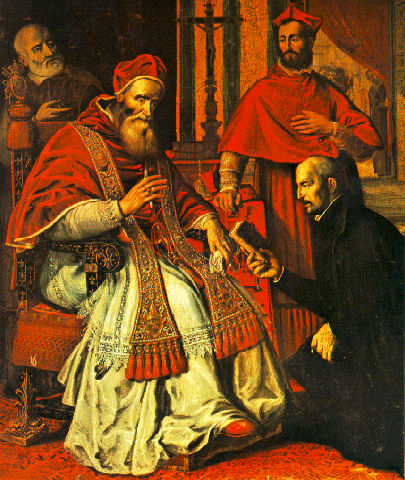
           More than a thousand years later St. Ignatius of Loyola is even more explicit in the Spiritual Exercises when he lists the rules “to have the true sentiment which we ought to have in the Church Militant”:  


Pope Paul III and St. Ignatius Loyola


To be right in everything, we ought always to hold that the white which I see, is black, if the Hierarchical Church so decides it, believing that between Christ our Lord, the Bridegroom, and the Church, His Bride, there is the same Spirit see which governs and directs us for the salvation of our souls. Because by the same Spirit and our Lord Who gave the ten Commandments, our holy Mother the Church is directed and governed.
                          
    St. Ignatius is not urging that Catholics leave their brain behind when they enter the Church: notice that he does not refer simply to white, but "the white which I see".  In other words, when it comes to fundamental categories (i.e., right and wrong), we need to trust the Church's judgment over our own, because she has been promised the guidance of the Holy Spirit, while we, as individuals, have not.


Every Man A Pope

    It really could not be any other way.  If we make ourselves the ultimate arbiters of truth instead of deferring to the Church, then the individual believer becomes, in effect, infallible, his or her own Pope, the result of which could only be thousands upon thousands of little schisms; any sort of real communion becomes impossible.  In fact, that is exactly what we see among our separated brethren in the Protestant communities, whose separate denominations are now said to number in the tens of thousands, less than five hundred years after Luther nailed his ninety-five theses to the church door in Wittenberg.
    In the end, faith itself becomes an impossibility, if there is no Truth greater than my own personal "truth".  And if I’m the supreme judge, why do I need a church to teach me anything? For that matter, what use is religion at all, or a Divine Savior, if it’s up to me to determine whether there’s any sin from which to save me? Isn’t that the logical end-point of the Hermeneutic of Suspicion?  Just myself, closed in upon myself. That’s an awfully cold, lonely way to spend eternity; it brings to mind what St. Paul says: “Wretched man that I am! Who will deliver me from this body of death?” (Romans 7:24).  Paul, of course, knows the answer: “Thanks be to God through Jesus Christ our Lord!” (Romans 7:25).  Only Christ can save me from myself, I myself who “do not do the good I want, but the evil I do not want” (Romans 7:19).  This same Christ has given His Church the power to bind and loose (Matthew 18:18); who am I, or any of us, to be its judge?

Thursday, September 10, 2015

Resist Him, Steadfast In Faith

   The Communion of Saints is one of Christ’s great gifts to the Church; we have more than enough intercessors and models of heroic virtue for any one of us. I like to go to Catholic Online (Catholic.org) and look at the biographies of some of the lesser-known saints, some of whom have led to posts on this blog (here, for instance, and here). There are 59 separate entries for today, September 10th. While many of them are from the same persecution in Japan in 1622, a random sampling finds Saints, mostly martyrs, from throughout the history of the Church; it is interesting how, as they say, the more things change, the more they stay the same. For instance:


St. Nemesian, Felix, and Companions
A group of Nicomedian martyrs condemned to labor in the marble quarries of Sigum. They all died in this arduous servitude. The group was comprised of nine bishops from Numidia, along with other clergy and laity. The bishops include Lucius, Litteus, Polyanus, Victor, Jader, Dativus, and a second Felix. St. Cyprian wrote to them from his place of exile. (c. 250?)

We are all familiar with the first three centuries of the Church as a time of persecution. The Romans took particular care to target the leaders of the Christian movement, the bishops.  There are places today (most notably Syria and Iraq) where Christians are persecuted with a ferocity equal to, or even greater than, that under the Romans.

St. Theodard of Maastricht
Bishop and martyr. A disciple of St. Remaclus in the Benedictine abbey of Malniely. Stavelot, Belgium, he succeeded him as abbot in 635, receiving appointment as bishop of Maastricht, Netherlands, in 662. He was murdered by a band of robbers in the forest of Bienwald, near Speyer, Germany, while on his way to defend the rights of the Church against the harsh confiscatory policies of King Childeric II (r. 662-675) of Austrasia. (670)

Imagine needing to “defend the rights of the Church against . . . harsh confiscatory policies”. We can’t think of anywhere today where the state is encroaching on the Church, can we?  In any case, here’s a Saint and who didn’t hesitate to stand up for Christ’s Church in the public square.

St. Cosmas of Aphrodisia
A bishop and martyr, born in Palermo, on Sicily. He was named bishop of Aphrodisia, ordained by Pope Eugene III. When the Saracens captured his see, Cosmas was seized and died as a result of harsh abuse. His cult was approved by Pope Leo XIII. (1160)

Speaking of Syria and Iraq, here we see a Catholic Bishop murdered by the Muslim jihadists of the day. While not always as virulent as it is under ISIS, persecution of Christians is endemic throughout the Islamic world.

St. Joseph of St. Hyacinth
Dominican martyr of Japan. He was born in Villareal, Spain. The provincial vicar of the Dominicans in Japan, he spoke perfect Japanese. Joseph was burned alive at Nagasaki.  He was beatified in 1867. (1622)

Bl. Lucy de Freitas
Martyr of Japan. A native Japanese, she was the widow of Philip de Freitas. Lucy, a Franciscan tertiary, was arrested for sheltering Blessed Richard of St. Anne, a Franciscan priest. Although advanced in age, Lucy defended the faith before the authorities and was burned to death for it at Nagasaki, Japan, on September 10. She was beatified in 1867. (1622)

St. Joseph and Blessed Lucy are just two of a large number of Christians martyred at Nagasaki in 1622; there is no part of the world that has not been baptized with the blood of Christian martyrs.
     Jesus says: “Blessed are you when men revile you and persecute you and utter all kinds of evil against you falsely on my account.” (Matthew 5:11) It’s going to happen. Sometimes it’s as ugly and brutal as it was for the Saints above, or as it is for many Christians in the Middle East today; sometimes it’s a much milder variety of uttering “all kinds of evil against you falsely”, as is becoming more common in the United States and other Western countries.  Nonetheless our own sufferings for the name of Christ, even when they don’t rise to the level of serious persecution, are still hardships and injustices. As St. Peter wrote:

Be sober and vigilant. Your opponent the devil is prowling around like a roaring lion looking for someone to devour. Resist him, steadfast in faith, knowing that your fellow believers throughout the world undergo the same sufferings. (1Peter 5:8-11)

The example of our brothers and sisters in Christ who have undergone, and are undergoing, much worse than we are shows us that we, too, can stand firm.