Showing posts with label dissent. Show all posts

Tuesday, January 30, 2018

"Progressive" Catholicism, Humanae Vitae and the Spirit of Vatican II

This Worth Revisiting post dates from September 26th, 2015, shortly before Pope Francis visited the United States. We'll be hearing more on this topic throughout this year as we commemorate the 50th anniversary of Pope Paul VI''s encyclical Humanae Vitae.

To enjoy the work of other faithful Catholic bloggers see Worth Revisiting Wednesday, hosted by Elizabeth Reardon at theologyisaverb.com and Allison Gingras at reconciledtoyou.com.


A Blast From The Past

   Some years ago, as part of a staff spiritual development project at a Catholic high school, I was asked to read and comment upon a number of excerpts from a book called A People Adrift: The Crisis Of The Roman Catholic Church In America, by a fellow named Peter Steinfels.  


I didn’t know much about the author at the time except that he and his wife had some connection with the leftish quasi-Catholic publication Commonweal.  I soon ascertained that he was very much of the “Spirit of Vatican II” school of Catholicism, in which the teaching and tradition of the Church often appears to serve as little more than window dressing for whatever enthusiasms are fashionable among the cultural elite.  It seems that it’s hard to maintain this stance if one is too particular about that doctrine and tradition, as I pointed out in one of my responses to the assigned reading:

Steinfels typically uses vague generalities when proposing his heterodox positions, as when he fails to cite any of the documents of Vatican II in his discussion of the council and the reform of the liturgy [literally not one citation in an entire chapter on the topic!]. Other times he simply ignores factual evidence that doesn’t fit his theses, as when he omits the scriptural background and the teaching of the Fathers in his discussion of contraception, and in his discussions of the current state of the Church he never mentions the ecclesial movements or some of the vibrant new publications spearheaded by lay Catholics.

I couldn’t possibly respond to every omission, distortion, and non-argument in his book, but still my comments grew longer and more elaborate with every chapter assigned. Finally, after reading his chapter on Humanae Vitae and contraception, I submitted a thirteen-page critique of Steinfels' argument and a defense of the Church’s centuries-old ban on contraception, with attached documentation of at least equal length.  It was an exhausting (and tiresome) exercise.
    The Catholic Left, however, never seems to tire of discussing Humanae Vitae and contraception.  Mr. Steinfels continues to opine on the topic in public, most recently just a couple weeks ago in the Washington Post [here], where he takes advantage of the publicity surrounding the Pope’s visit to the United States and next month’s Synod on the Family in Rome to renew his campaign to persuade the Catholic Church to abandon its condemnation of contraception.  

The More Things Change . . .

    As for Steinfels’ arguments, well, not much has changed over the past ten years.  To begin with, he tries to minimize the Catholic teaching on contraception with the usual red herrings and non-sequiturs:

The church’s sexual norms were woven out of the Old Testament, apostolic injunctions and classical doctrines such as Stoicism, which held passion suspect and condemned sexual acts not directed toward procreation as “against nature.”
But unlike, say, adultery or fornication or defining the conditions of a valid marriage, contraception was a relatively marginal issue until the 20th century, when reliable methods replaced a brew of folk remedies. Before that, birth control was associated with prostitution or illicit sex and decried by virtually all Christian denominations . When Anglican churches broke that pattern in 1930, followed by many Protestant denominations, Pope Pius XI reacted with a stern encyclical reasserting the condemnation. Opposition to birth control soon became a kind of identifying mark of Catholicism.
So, the implication is that a centuries-old doctrine can be done away with because 1) it’s based on the Bible, the teaching of the Early Church, and Classical moral philosophy, 2) we can accomplish the proscribed activity much more effectively now than we could in the past, 3) said activity was formerly associated with prostitutes, but now, apparently, behaving like a prostitute is no longer a big deal, and 4) the Anglicans and other Protestant bodies changed the teaching, and they’re doing just fine, aren’t they? . . .  At least the ones who are left. This last point is especially funny, given the massive decline of those ecclesial bodies after their acceptance of contraception, when the the main point of Steinfels’ essay is that banning contraception is driving decline in the Catholic Church.  As a matter of fact, along with points 1 through 3, this actually sounds more like an argument for maintaining the prohibition on contraception, doesn’t it?
Lies, Damned Lies, And Statistics
    There is also the usual unspoken assumption among the “progressive” set that Catholics can somehow vote to repeal unwelcome moral teachings.  He trots out the the notorious “600 theologians” who, in the best traditions of theological discourse, published a full-page ad in the New York Times the day after Humanae Vitae was promulgated in order to proclaim their opposition (one wonders when they found the time to study its arguments, or whether, in fact, they read it at all).  We are asked to accept uncritically the thoroughly unbiblical, uncatholic, and ahistorical notion that, on matters of faith and morals, academics in university theology departments can overrule the Successors of the Apostles.
    We also hear from the voice of the supposedly faithful laity:
Approximately 80 percent of U.S. Catholics, including the thoroughly devout, disagree with that stance [i.e. the prohibition of contraception] (support for changing the ruling is nearly as high around the world). And the vast majority ignore the teaching altogether — one study suggests that 68 percent of sexually active American Catholic women have used birth control, sterilization or IUDs.    
Blessed Paul VI, author of Humanae Vitae
This last quote is a good example of just how slippery these statistics can be: what precisely does “thoroughly devout" mean? Who gets to decide who falls into this category? How can one be “thoroughly" devout if one rejects the teaching of the Church to which one is supposedly devoted? Notice also the careful parsing of “68 percent of sexually active American Catholic women have used birth control.” First of all, I’m surprised the percentage isn’t higher, because we live in a culture where contraception is the norm, where doctors routinely prescribe birth control pills to teenaged girls without a second thought.  That makes it easy to distort the real situation: by including all women who have used birth control, Steinfels is putting in the anti-Humanae Vitae camp the growing number of women who, on the contrary, have embraced the encyclical's teaching after trying the current conventional wisdom and finding it sadly wanting.  Quite a few of the public promoters of Humanae Vitae's teachings today, in fact, are lay people who have gone this route.  More importantly, it doesn't matter how unpopular it might be, Doctrine isn't made, or unmade, by popular opinion: it's Doctrine because the Magisterial Church to which Christ gave the power of binding and loosing (Matthew 18:18) has determined that it's the truth.
The Truth
    That, finally, is the fundamental problem with the Steinfelsian approach, not only in regard to Blessed Paul VI’s encyclical, but to everything.  There is no sense of coming to terms with The Truth: everything is put in terms of a battle of opinions, as if this were a wrangling over a political platform, where whoever can concoct the more persuasive argument "wins". For instance, Steinfels writes:
At last October's Synod on the Family . . . the discussion of contraception was perfunctory.  The bishops simply called on the church [sic -lower case in original] to do a better job of propagating "the message of the encyclical Humanae Vitae." In other words, the rejection of the birth- control ban is simply a messaging problem.
Well, no, it doesn't necessarily follow that the bishops consider it a "messaging problem", which is political jargon for not “selling” your position in a way that appeals to voters. I suspect the bishops were more concerned about the fact that the Church, in the person of its bishops and priests, virtually never mentions the topic at all (for more on that point, see here).  For Steinfels, however, and for "progressive" (another political term) Catholics in general, politics seems to be the prism through which they view everything, including their faith.  Instead of the traditional definition of theology, "Faith seeking Understanding", we have merely "policy preferences seeking justification". That’s not the sort of thing that inspires ordinary people to become saints.
   And yet, sainthood is what we are all striving for, isn't it?  St. John Paul the Great used to exhort us to embrace the “Adventure of Orthodoxy”, and “Set Out Into the Deep”; Mr. Steinfels is willing to settle for “give the people what they want”.  Which one sounds like he’s talking about the Church of Jesus Christ?   

Saturday, October 15, 2016

St. Antiochus of Lyons & the Will of God

Today the Church commemorates a truly great saint, St. Theresa of Avila.  A Doctor of the Church, she was at the same time one of the great mystical writers of all time and a hard-nosed pragmatist who, along with St. John of the Cross, led a much-need reform of the Carmelite order.  Her reform efforts were not welcome to everyone: she met strong, sometimes violent, resistance from her fellow Carmelites. We can all grow in Christ through her example of total surrender to our Lord, and it comes as no surprise that there are any number of beautifully written and insightful meditations on this amazing saint today.
    One disadvantage of the large shadow casts by giants of sanctity like St. Theresa, however, is that lesser-known saints who share the same day on the liturgical calendar can go unnoticed.  I’d like to look at one of these holy men and women, St. Antiochus of Lyons, whose feast we also celebrate on October 15th.
The sources I’ve been able to locate on St. Antiochus are brief, but tell an intriguing story.  He was a 5th century priest of Lyons, in what was then still called Gaul (the modern country of France).  The bishop of Lyons, St. Justus, abdicated his office and left for Egypt to become a hermit in the desert.  The people of Lyons sent Antiochus on the long journey to Egypt to persuade their holy shepherd to return to his flock.  Justus, apparently, was unwilling or unable to comply, and Antiochus returned home, an apparent failure.  The people of the diocese, however, recognizing that “the Lord gives and the Lord takes away” (Job 1:21) saw in the failure of Antiochus’ mission a gift as well: a new bishop.  They promptly chose Antiochus to replace the departed Justus as their spiritual father.  We are told that he went about his new office “with zeal and firmness” until he was called to his final reward.

Egyptian hermitage
    St. Antiochus, very much like St. Bridget of Sweden, is one of those saints who seems to have failed in his primary mission, only to discover that his failure there really served to prepare him for a success greater than he had dared to imagine. We learn from the lives of saints like Antiochus is that the path to sanctity lies not so much in our own efforts as it does in accepting the will of God.  Even more, the failure of these holy men and women here on earth reminds us that whatever we do accomplish, or fail to do, here only matters for a little while; our true mission is not only loving and serving God in this world, as the Baltimore Catechism puts it, but enjoying eternal happiness with him in the next.
Let us all prayer for the Grace to join St. Antiochus, St. Theresa of Avila, and all their fellow saints before the Throne of God.
 

Thursday, April 28, 2016

Is The Catholic Church A Political Animal?

   Right now we are in the midst of an unusually rambunctious presidential election here in the United States. It seems a good time to revisit this Throwback to April 15th 2015 (first published on the blog Nisi Dominus), which looks at the difference between secular politics and "politics" within the Church.

   You’re going to find politics wherever people gather, or so someone once told me when I had objected to using the secular political terms “liberal” and “conservative” to describe different factions within the Catholic Church.  And he was right, if by “politics” we mean the small-p wrangling that unavoidably accompanies any human enterprise requiring two or more people.  But that is a very different thing from Politics, of the partisan variety.  The Church is not a political party, and does not work like a political party.  Nor should it.

Synod on the Family October 2015 (photo: Vatican Radio News)

     That may seem an obvious point to you and to me, but it’s not at all obvious to everybody.  It’s a distinction lost on a large number of people outside of the Church for instance, for many of whom politics has taken the place of religion, and so has become the lens through which they interpret everything. Many such people have come to dominate the secular media in the developed world, with the result that the mass media projects the secular political model onto the Church, with bad guys called conservatives working to thwart the good guys, the liberals (sometimes referred to as progressives), who are fighting to bring about a kinder, better Catholic Church more in step with The Times.  This is the only model of the inner-workings of the Church most people see, including most ordinary Catholics, unless they intentionally seek out Catholic publications which reject this distorted view (sadly, many self-identified Catholic outlets do not).
     That is not to say that there isn’t a wide range of legitimate differences of opinion within the Church; there most certainly is.  Unlike a political party, however, where major policy planks can change overnight with a vote of the membership (and why not? They’re only opinions), there are many things in the Church which are grounded in Divine Revelation, and are therefore not up for negotiation.  This vital distinction was expressed very clearly by then prefect of the Congregation for the Doctrine of the Faith, Cardinal Joseph Ratzinger (now Pope Emeritus Benedict XVI) in 2004.  Senator John Kerry, the nominee of the Democratic Party for President of the United States, was widely criticized for receiving communion and touting his Catholic bona fides despite his open advocacy for legal abortion and other positions contrary to Catholic moral teaching.  Accordingly, Cardinal Ratzinger wrote a letter (later published by the Holy See under the title “Worthiness to Receive Holy Communion: General Principles”) to Kerry’s ordinary, then Archbishop of Washington, D.C. Theodore McCarrick,  which gives an excellent example of how the Church is different from a political party.  For instance, Cardinal Ratzinger writes:

Not all moral issues have the same moral weight as abortion and euthanasia.  For example, if a Catholic were to be at odds with the Holy Father on the application of capital punishment or on the decision to wage war, he would not for that reason be considered unworthy to present himself to receive Holy Communion.  While the Church exhorts civil authorities to seek peace, not war, and to exercise discretion and mercy in imposing punishment on criminals, it may still be permissible to take up arms to repel an aggressor or to have recourse to capital punishment.  There may be a legitimate diversity of opinion even among Catholics about waging war and applying the death penalty, but not however with regard to abortion and euthanasia.

Joseph Cardinal Ratzinger (now Pope Emeritus Benedict XVI)
     This crucial difference can be obscured by applying secular political terms to church “politics”.  Political parties often change even basic positions, and this is sometimes a good thing: consider that, when I was a child, many prominent leaders in the Democratic Party in the United States were unapologetic White Supremacists and segregationists. Such a position would be unthinkable today, and yet nobody doubts that the Democratic Party is still the Democratic Party.  Using the political analogy can create the impression that proposed changes in the Church are benign or even desirable changes of the same sort.The difference between abortion and euthanasia on the one hand and war and capital punishment on the other is that the Church has always taught that the first two are intrinsically evil, and so never permissible; this teaching is part of the deposit of faith and cannot change, and to publicly oppose it is to separate oneself from the Church (hence the unworthiness to receive communion).  In the case of war and capital punishment, the Church has taught that, in some instances, they may be morally licit, a teaching that likewise cannot change.  While there are certain moral principles that bind a Catholic here (e.g., the Just War Doctrine), the actual application of these principles belongs to the prudential judgment of individual Catholic decision makers.  It is in matters of prudential judgment that legitimate differences of opinion may arise.

     Many so-called liberals in the Church today, however, are not advocating simply the more “liberal” application of unchanging principles in prudential situations, but are pushing for changing more foundational things like the teaching on marriage, the meaning of priesthood, sexual morality, etc.  The Catholic Church, however, can’t change its teachings and still remain the Catholic Church. One can usually make a case for being either a conservative or a liberal in political matters, but when it comes to Church Doctrine, we can only be Catholic . . . or Not. 

Thursday, February 25, 2016

The Pope Is Catholic Yet Again . . .

One of the constants of the current Pontificate is that we can rely on the secular press (and, sadly, some ostensibly Catholic outlets as well) to misrepresent what Pope Francis is saying, particularly when it comes to his unprepared comments.  Remarks that can be interpreted in such a way that they seem to support the current secular enthusiasms will be presented in that way, while utterances that contradict the spirit of the age will be downplayed or ignored. We've seen it happen again with some of the  Pope's comments during his recent trip to Mexico; the post below is a throwback to last year (February 22nd, 2015), after a papal trip to the Phillipines.  Yet again, the real Pope is much more Catholic than the Pope depicted in the news media.

.  
Who would have guessed that the Pope is Catholic?

     It’s funny that Pope Francis is the most quotable of Popes . . . except when he’s not.  A few weeks ago, when he appeared to criticize couples who were ‘irresponsible” in having children “in a series”, dismissing the idea that, “in order to be good Catholics, we have to be like rabbits,” it was big news.  More recently, when he said that “Not to have children is a selfish choice,” and suggested that a culture that “views children above all as a worry, a burden, a risk, is a depressed society,” well, where was the news media?  Where are the “Spirit of Vatican II” Catholics who trumpet every reference to rabbits and every off-the-cuff  “who am I to judge” remark?  Yes, it was reported (mostly in non-U.S. outlets), but given very little play and quickly forgotten, especially compared to the hullaballoo surrounding some other comments from this Pope.
     Not that any of this is a surprise, of course.  Since the revolt against the Church’s teaching on contraception that erupted into public view at the issuance of Paul VI’s encyclical Humanae Vitae in 1968, reproduction and sexuality have been Ground Zero in the culture of dissidence that exists within the Church.  Not coincidentally, those are also the issues that animate the drivers of cultural trends in the secular world as well.  The “news” media is a major component in the Spirit of this Age, and so it is happy to run with anything the Pope says that could further its agenda, especially if it can be spun to undercut Catholic moral teaching on their favored issues.
     It may be hard for some of us to believe just how important this last point is to the promoters of the new sexual ethic.  They quite correctly see the Church as the main obstacle in their way.  The Popes agree.  In his encyclical letter Casti Connubii (“Of Chaste Marriage”), published in response to the abandonment by the Anglican Church of the age-old Christian ban on contraception, Pope Pius XI describes:

. . . the Catholic Church, to whom God has entrusted the defense of the integrity and purity of morals, standing erect in the midst of the moral ruin which surrounds her . . . (Casti Connubii, 56)

     If this description was true in 1930, when Casti Connubii was published, how much more so today?  Not only are the moral ruins around us more widespread than ever, but there is a visible group of people who identify as Catholic actively working to pull down the Church into that debris.  Pope Francis’ remarks on the selfishness of sterility are most unwelcome both to this set of Catholics, and to the media, not only because he is contradicting their agenda, but specifically because he is re-stating long-standing Catholic teaching.  These comments give the lie to the mythical Pope Francis who is freeing the Catholic Church from its judgmental and puritanical past.  And we can’t have people think the Pope really is Catholic, can we?


Saturday, October 24, 2015

"To Whom Shall We Go? You Have The Words Of Eternal Life" (from Nisi Dominus)

    Our first child seemed reluctant to be born.  The baby (we didn't yet know whether boy or girl) was almost two weeks overdue, however, when we went to Mass one Sunday in March, so we knew that we would have a newborn child in our home before the Lord's day came around again.  We heard this first reading at that Mass:

And Jesse made seven of his sons pass before Samuel. And Samuel said to Jesse, "The LORD has not chosen these." And Samuel said to Jesse, "Are all your sons here?" And he said, "There remains yet the youngest, but behold, he is keeping the sheep." And Samuel said to Jesse, "Send and fetch him; for we will not sit down till he comes here."
And he sent, and brought him in. Now he was ruddy, and had beautiful eyes, and was handsome. And the LORD said, "Arise, anoint him; for this is he."
Then Samuel took the horn of oil, and anointed him in the midst of his brothers; and the Spirit of the LORD came mightily upon David from that day forward. And Samuel rose up, and went to Ramah.
(1 Samuel 16:10-13)


St. Frances X. Cabrini Church, Scituate, MA (Boston Globe photo)
We had not yet settled on a name for our baby, although "David" was on the short list. Now we were sure that our child would be a boy, and that we would name him David (as an aside, we heard the same reading six years later before the birth of our youngest son, whom we had already decided would be named Samuel if he were a boy).
    Now, almost twenty years later and several states away, I see this same little church is in the news, but the news is not as happy as it was for us and our son David.  Granted, if you look at the Friends of St. Frances X. Cabrini website, you see all the signs of thriving, vibrant parish: a wide range of charitable works and causes, parish activities such as craft fairs and picnics, prayer services, etc.  Most pastors would be ecstatic to have such involved, committed parishioners, except . . . there is no pastor.  There is, in fact, no parish any longer.  St. Francis X. Cabrini was one of several dozen parishes ordered closed by the Archdiocese of Boston 11 years ago, and the people devoting so much time and energy to their local church in Scituate have been occupying the property all these years in direct defiance of their bishop . . .

(To read the rest of this post go HERE)

Monday, October 12, 2015

What Is A "Hermeneutic Of Suspicion", And Why Does It Matter?

What The Heck Is Hermeneutics?  

Back in my undergraduate days my roommate took a class called "Hermeneutics." Not surprisingly, I felt compelled to ask, "What the heck is hermeneutics?" He explained that the word comes from the Greek word ἑρμηνεύω (hermeneuo) "to interpret", and is related to the name of the god Hermes, bringer and interpreter of dreams. Hermeneutics, then, means interpretation, and when we speak of a hermeneutic, we mean a framework through which one interprets raw information.  Even if we don't know the term, we all know the concept: if we say someone "sees the world through rose colored glasses", for instance, we mean that they employ a "hermeneutic of optimism"; if you refer to another person as being "always under a dark cloud", they have a "hermeneutic of pessimism".  If we want a somewhat more sophisticated example, someone who uses a Marxist hermeneutic interprets everything through to the lens of Class Struggle.

Hermes the Interpreter
    For most of us it seems a pretty esoteric word, and even if it's a part of our working vocabulary, it's probably not included in our everyday vocabulary.  Nonetheless, it's a handy term to have.  It gave Joseph Ratzinger (later Pope Benedict XVI), for instance, a very clear and precise way of summing up the the foundational error of both the "Spirit of Vatican II" progressives and the Lefebvrist ultra-traditionalists: both camps interpret the Second Vatican Council through a "hermeneutic of rupture", when the council should more properly be viewed through a "hermeneutic of continuity".  In other words, both groups operate with the assumption that Vatican II is a decisive break with the previous nineteen centuries of Catholic Tradition, the only difference being one group thinks that's a good thing, the other decidedly not.  Ratzinger was proposing that instead we should interpret the council with and through that Tradition.


The Hermeneutic of Suspicion

     A similar problem, one that can be found not only among die-hard progressives and rad trads, but also among many people who consider themselves "faithful Catholics, but . . ." (and in fact it's a temptation for all of us), is the "Hermeneutic of Suspicion". In other words, the default position that for any issue on which the Church takes a stance contrary to my preconceived ideas, political loyalties, the prevailing popular wisdom, or whatever else, She must convince me, beyond a shadow of a doubt, that my position is wrong and that her position is right.  This hermeneutic of suspicion is most conspicuously at play in the massive dissent from the traditional Catholic teaching on sexuality and family (which is not limited, by the way, to those who consider themselves "progressive").
    Am I saying that to be a good Catholic we need to stop thinking for ourselves, or "mindlessly" go along with the Church, as anti-Catholics are fond of telling us?  Not at all.   But nobody thinks and decides in a vacuum, we all need some basis for interpreting our world; "give me a place to stand", said Archimedes, "and I will move the world".  Being Catholic has always meant that we stand on the moral and metaphysical framework provided by Christ 's Church, and the Gospel as understood by that Church, not by the conventional wisdom or the prejudices of the cultural elite.


The Pillar and Foundation of Truth

    The demand that the Church must exhaustively prove to my satisfaction any teaching that does not correspond to my preferences before I believe, in fact,  seems to me to be the exact opposite of what has been normative for those who consider themselves faithful Catholics throughout the history of the Church.  St. Paul refers to “the church of the living God” as “the pillar and foundation of truth” (1 Tim. 3:15), and in another place he makes explicit where the believer is to stand in case of conflict between the Truth of God and the conventional wisdom:
           Let no one deceive himself. If any one among you considers himself wise in this age, let him become a fool so as to become wise.  For the wisdom of this world is foolishness in the eyes of God, for it is written: "He catches the wise in their own ruses," and again: "The Lord knows the thoughts of the wise, that they are vain."  (1 Cor. 3:18-20)
It was understood in the early Church as well, where the authority to make final and binding decisions lay.  St. Augustine once said:
For already two councils on this question have been sent to the apostolic see; and replies have also come from there.  The cause is finished [causa finita est]; would that the error might be sometime finished also! (Sermon 131:10)
The expression causa finita est  comes from the practice of law; the modern expression that most closely corresponds to causa finita est is “case closed!”  To Augustine it seems a given that the replies from Rome have ended the discussion.
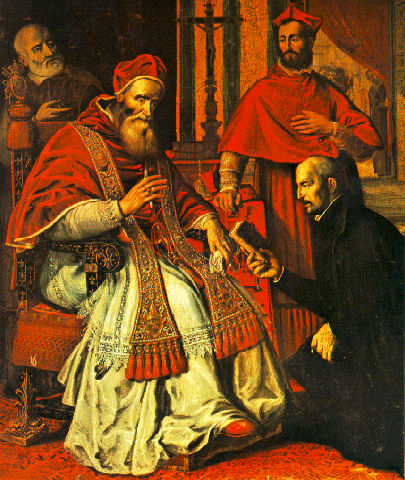
           More than a thousand years later St. Ignatius of Loyola is even more explicit in the Spiritual Exercises when he lists the rules “to have the true sentiment which we ought to have in the Church Militant”:  


Pope Paul III and St. Ignatius Loyola


To be right in everything, we ought always to hold that the white which I see, is black, if the Hierarchical Church so decides it, believing that between Christ our Lord, the Bridegroom, and the Church, His Bride, there is the same Spirit see which governs and directs us for the salvation of our souls. Because by the same Spirit and our Lord Who gave the ten Commandments, our holy Mother the Church is directed and governed.
                          
    St. Ignatius is not urging that Catholics leave their brain behind when they enter the Church: notice that he does not refer simply to white, but "the white which I see".  In other words, when it comes to fundamental categories (i.e., right and wrong), we need to trust the Church's judgment over our own, because she has been promised the guidance of the Holy Spirit, while we, as individuals, have not.


Every Man A Pope

    It really could not be any other way.  If we make ourselves the ultimate arbiters of truth instead of deferring to the Church, then the individual believer becomes, in effect, infallible, his or her own Pope, the result of which could only be thousands upon thousands of little schisms; any sort of real communion becomes impossible.  In fact, that is exactly what we see among our separated brethren in the Protestant communities, whose separate denominations are now said to number in the tens of thousands, less than five hundred years after Luther nailed his ninety-five theses to the church door in Wittenberg.
    In the end, faith itself becomes an impossibility, if there is no Truth greater than my own personal "truth".  And if I’m the supreme judge, why do I need a church to teach me anything? For that matter, what use is religion at all, or a Divine Savior, if it’s up to me to determine whether there’s any sin from which to save me? Isn’t that the logical end-point of the Hermeneutic of Suspicion?  Just myself, closed in upon myself. That’s an awfully cold, lonely way to spend eternity; it brings to mind what St. Paul says: “Wretched man that I am! Who will deliver me from this body of death?” (Romans 7:24).  Paul, of course, knows the answer: “Thanks be to God through Jesus Christ our Lord!” (Romans 7:25).  Only Christ can save me from myself, I myself who “do not do the good I want, but the evil I do not want” (Romans 7:19).  This same Christ has given His Church the power to bind and loose (Matthew 18:18); who am I, or any of us, to be its judge?

Saturday, September 26, 2015

Progressive Catholicism, The Spirit of Vatican II, and Humanae Vitae

A Blast From The Past

   Some years ago, as part of a staff spiritual development project, I was asked to read and comment upon a number of excerpts from a book called A People Adrift: The Crisis Of The Roman Catholic Church In America by a fellow named Peter Steinfels.  I didn’t know much about the author at the time except that he and his wife had some connection with the leftish quasi-Catholic publication Commonweal.  I soon ascertained that he was very 


much of the “Spirit of Vatican II” school of Catholicism, in which the teaching and tradition of the Church often appears to serve as little more than window dressing for whatever enthusiasms are fashionable among the cultural elite.  It seems that it’s hard to maintain this stance if one is too particular about that doctrine and tradition, as I pointed out in one of my responses to the assigned reading:


Steinfels typically uses vague generalities when proposing his heterodox positions, as when he fails to cite any of the documents of Vatican II in his discussion of the council and the reform of the liturgy. Other times he simply ignores factual evidence that doesn’t fit his theses, as when he omits the scriptural background and the teaching of the Fathers in his discussion of contraception, and in his discussions of the current state of the Church he never mentions the ecclesial movements or some of the vibrant new publications spearheaded by lay Catholics.


I couldn’t possibly respond to every omission, distortion, and non-argument in his book, but still my comments grew longer and more elaborate with every chapter assigned, until finally, after reading his chapter on Humanae Vitae and contraception, I submitted a thirteen-page critique of Steinfels' argument and a defense of the Church’s centuries-old ban on contraception, with attached documentation of at least equal length.  It was an exhausting (and tiresome) exercise.
    The Catholic Left, however, never seems to tire of discussing Humanae Vitae and contraception.  Mr. Steinfels continues to opine on the topic in public, most recently just a couple weeks ago in the Washington Post [here], where he takes advantage of the publicity surrounding the Pope’s visit to the United States and next month’s Synod on the Family in Rome to renew his campaign to persuade the Catholic Church to abandon its condemnation of contraception.  

The More Things Change . . .

    As for Steinfels’ arguments, well, not much has changed over the past ten years.  To begin with, he tries to minimize the Catholic teaching on contraception with the usual red herrings and non-sequiturs:

The church’s sexual norms were woven out of the Old Testament, apostolic injunctions and classical doctrines such as Stoicism, which held passion suspect and condemned sexual acts not directed toward procreation as “against nature.”
But unlike, say, adultery or fornication or defining the conditions of a valid marriage, contraception was a relatively marginal issue until the 20th century, when reliable methods replaced a brew of folk remedies. Before that, birth control was associated with prostitution or illicit sex and decried by virtually all Christian denominations . When Anglican churches broke that pattern in 1930, followed by many Protestant denominations, Pope Pius XI reacted with a stern encyclical reasserting the condemnation. Opposition to birth control soon became a kind of identifying mark of Catholicism.
So, the implication is that a centuries-old doctrine can be done away with because 1) it’s based on the Bible, the teaching of the Early Church, and Classical moral philosophy, 2) we can accomplish the proscribed activity much more effectively now than we could in the past, 3) said activity was formerly associated with prostitutes, but now, apparently, behaving like a prostitute is no longer a big deal, and 4) the Anglicans and other Protestant bodies changed the teaching, and they’re doing just fine, aren’t they? . . .  At least the ones who are left. This last point is especially funny, given the massive decline of those ecclesial bodies after their acceptance of contraception, when the the main point of Steinfels’ essay is that banning contraception is driving decline in the Catholic Church.  In fact, along with points 1 through 3, this actually sounds more like an argument for maintaining the prohibition on contraception, doesn’t it?
Lies, Damned Lies, And Statistics
    There is also the usual unspoken assumption among the “progressive” set that Catholics can somehow vote to repeal unwelcome moral teachings.  He trots out the the notorious “600 theologians” who, in the best traditions of theological discourse, published a full-page ad in the New York Times the day after Humanae Vitae was promulgated in order to proclaim their opposition (one wonders when they found the time to study its arguments, or whether, in fact, they read it at all).  We are asked to accept uncritically the thoroughly unbiblical, uncatholic, and ahistorical notion that, on matters of faith and morals, academics in university theology departments can overrule the Successors of the Apostles.
    We also hear from the voice of the supposedly faithful laity:
Approximately 80 percent of U.S. Catholics, including the thoroughly devout, disagree with that stance [i.e. the prohibition of contraception] (support for changing the ruling is nearly as high around the world). And the vast majority ignore the teaching altogether — one study suggests that 68 percent of sexually active American Catholic women have used birth control, sterilization or IUDs.    
Blessed Paul VI, author of Humanae Vitae
This last quote is a good example of just how slippery these statistics can be: what precisely does “thoroughly devout" mean? Who gets to decide who falls into this category? How can one be “thoroughly" devout if one rejects the teaching of the Church to which one is supposedly devoted? Notice also the careful parsing of “68 percent of sexually active American Catholic women have used birth control.” First of all, I’m surprised the percentage isn’t higher, because we live in a culture where contraception is the norm, where doctors routinely prescribe birth control pills to teenaged girls without a second thought.  That makes it easy to distort the real situation: by including all women who have used birth control, Steinfels is putting in the anti-Humanae Vitae camp the growing number of women who, on the contrary, have embraced the encyclical's teaching after trying the current conventional wisdom and finding it sadly wanting.  Quite a few of the public promoters of Humanae Vitae's teachings today, in fact, are lay people who have gone this route.  More importantly, it doesn't matter how unpopular it might be, Doctrine isn't made, or unmade, by popular opinion: it's Doctrine because the Magisterial Church to which Christ gave the power of binding and loosing (Matthew 18:18) has determined that it's the truth.
The Truth
    That, finally, is the fundamental problem with the Steinfelsian approach, not only in regard to Blessed Paul VI’s encyclical, but to everything.  There is no sense of coming to terms with The Truth: everything is put in terms of a battle of opinions, as if this were a wrangling over a political platform, where whoever can concoct the more persuasive argument "wins". For instance, Steinfels writes:
At last October's Synod on the Family . . . the discussion of contraception was perfunctory.  The bishops simply called on the church [sic -lower case in original] to do a better job of propagating "the message of the encyclical Humanae Vitae." In other words, the rejection of the birth- control ban is simply a messaging problem.
Well, no, it doesn't necessarily follow that the bishops consider it a "messaging problem", which is political jargon for not “selling” your position in a way that appeals to voters. I suspect the bishops were more concerned about the fact that the Church, in the person of its bishops and priests, virtually never mentions the topic at all (for more on that point, see here).  For Steinfels, however, and for "progressive" (another political term) Catholics in general, politics seems to be the prism through which they view everything, including their faith.  Instead of the traditional definition of theology, "Faith seeking Understanding", we have merely "policy preferences seeking justification". That’s not the sort of thing that inspires ordinary people to become saints.
   And yet, saints is what we are called to be.  St. John Paul the Great used to exhort us to embrace the “Adventure of Orthodoxy”, and “Set Out Into the Deep”; Mr. Steinfels is willing to settle for “give the people what they want”.  Which one sounds like he’s talking about the Church of Jesus Christ?