Showing posts with label magisterium. Show all posts

Thursday, May 5, 2016

Our Eternal Destiny: Armed Robbery, or A Warm Place By The Fire?

Today is Ascension Thursday; click here for my Ascension Thursday post on the blog Nisi Dominus. The throwback below, which first appeared on Nisi Dominus April 19th 2015, examines the (apparently) vexing question as to how Eternal Salvation differs from a mugging.. 

  Analogical thinking, it would appear, is a dying art.  I recently heard Catholic apologist and scholar Peter Kreeft on Catholic radio, and he was pointing out that brains which spend a lot of time interacting with video games and various other electronic devices simply don’t develop in the same way as those formed by extensive reading.  Among the those things that are undernourished are linear and analogical thinking.  Professor Kreeft has found that this makes it difficult to teach a subject like Theology that requires dealing with a lot of difficult and abstract ideas.


Is this your image of God?
     Over my own nearly 30 years of teaching high school students I’ve observed the same trend.  Fortunately, we still have a long way to go: while many people, especially young people, may not be as quick to grasp them as they might have been several decades ago, analogies are still the most effective way to communicate many ideas.  They have always been a preferred way of explaining Christian Doctrine: think of the parables of Jesus, or St. Paul's comparison in 1st Corinthians of the Church to a body, with all the members working together at their own assigned tasks; not only that, but one of the four traditional Levels of Meaning in scripture, the Allegorical, relies very heavily on analogical thinking.  Analogy is often the only reliable way for us who are composed of both spirit and matter to understand spiritual realities.
     Not surprisingly, analogies are also an essential tool in any dialogue with atheists and agnostics.  I recently became aware of the following analogy, which is appears to be in vogue in atheist circles: God, as we Christians envision Him, is like an armed robber with a gun to our heads, and he is offering a choice between giving him all our money (i.e., living according to the Gospel and spending eternity in Heaven), or having our brains blown out (which is spending eternity in Hell).
     Now, clearly, there are some very obvious problems with this analogy.  The vast majority of people, even many non-Christians, will have a hard time seeing going to Heaven as equivalent to getting mugged, even if we accept the premise that living a Christian life “robs” us of pleasures we might otherwise enjoy: Heaven promises something infinitely better than anything available here, whereas an armed robber does not even pretend to make our life better than it was before we met him.  And of course there is quite a lot of secular, sociological evidence that following God’s law actually makes us happier in the here-and-now.  Also, the robber analogy depicts Hell as something that God imposes on us, in which we take no initiative at all, when in fact the Catholic conception of Hell is that it is something that we choose for ourselves, contrary to God’s wish, by our rejection of his freely offered love.


Wouldn't you rather be inside?
     I propose a better analogy to communicate the eternal choice which God presents to us.  Imagine that we are standing outdoors on a cold, rainy night.  Somebody opens a door and invites us to come inside with them, where it is warm and dry (although, of course, we need to take off our wet muddy boots and our wet, dripping coats).  That’s God’s offer of eternal salvation.  We can say yes, although we are equally free to say no.  In fact, we can say “No, you can’t tell me what to do! Besides, can you prove it’s really warm and dry in there before I go in?”  and remain out in cold, wet darkness.  That’s Hell, the product of nothing but our own pride and stubbornness.


     The second analogy presents a much more accurate image of the Catholic view of our eternal destiny.  Not only that, when juxtaposed to the “armed robber” scenario, it also casts light behind it, as it were, giving observers a vivid illustration of the different worldviews that have generated each analogy: the atheist worldview which is concerned with power, force, and will, and in which one party must be the loser, and the Christian perspective, which envisions a reality in which love can triumph, and everyone can win.  Which is likely to appeal to more people in the end?

Thursday, April 28, 2016

Is The Catholic Church A Political Animal?

   Right now we are in the midst of an unusually rambunctious presidential election here in the United States. It seems a good time to revisit this Throwback to April 15th 2015 (first published on the blog Nisi Dominus), which looks at the difference between secular politics and "politics" within the Church.

   You’re going to find politics wherever people gather, or so someone once told me when I had objected to using the secular political terms “liberal” and “conservative” to describe different factions within the Catholic Church.  And he was right, if by “politics” we mean the small-p wrangling that unavoidably accompanies any human enterprise requiring two or more people.  But that is a very different thing from Politics, of the partisan variety.  The Church is not a political party, and does not work like a political party.  Nor should it.

Synod on the Family October 2015 (photo: Vatican Radio News)

     That may seem an obvious point to you and to me, but it’s not at all obvious to everybody.  It’s a distinction lost on a large number of people outside of the Church for instance, for many of whom politics has taken the place of religion, and so has become the lens through which they interpret everything. Many such people have come to dominate the secular media in the developed world, with the result that the mass media projects the secular political model onto the Church, with bad guys called conservatives working to thwart the good guys, the liberals (sometimes referred to as progressives), who are fighting to bring about a kinder, better Catholic Church more in step with The Times.  This is the only model of the inner-workings of the Church most people see, including most ordinary Catholics, unless they intentionally seek out Catholic publications which reject this distorted view (sadly, many self-identified Catholic outlets do not).
     That is not to say that there isn’t a wide range of legitimate differences of opinion within the Church; there most certainly is.  Unlike a political party, however, where major policy planks can change overnight with a vote of the membership (and why not? They’re only opinions), there are many things in the Church which are grounded in Divine Revelation, and are therefore not up for negotiation.  This vital distinction was expressed very clearly by then prefect of the Congregation for the Doctrine of the Faith, Cardinal Joseph Ratzinger (now Pope Emeritus Benedict XVI) in 2004.  Senator John Kerry, the nominee of the Democratic Party for President of the United States, was widely criticized for receiving communion and touting his Catholic bona fides despite his open advocacy for legal abortion and other positions contrary to Catholic moral teaching.  Accordingly, Cardinal Ratzinger wrote a letter (later published by the Holy See under the title “Worthiness to Receive Holy Communion: General Principles”) to Kerry’s ordinary, then Archbishop of Washington, D.C. Theodore McCarrick,  which gives an excellent example of how the Church is different from a political party.  For instance, Cardinal Ratzinger writes:

Not all moral issues have the same moral weight as abortion and euthanasia.  For example, if a Catholic were to be at odds with the Holy Father on the application of capital punishment or on the decision to wage war, he would not for that reason be considered unworthy to present himself to receive Holy Communion.  While the Church exhorts civil authorities to seek peace, not war, and to exercise discretion and mercy in imposing punishment on criminals, it may still be permissible to take up arms to repel an aggressor or to have recourse to capital punishment.  There may be a legitimate diversity of opinion even among Catholics about waging war and applying the death penalty, but not however with regard to abortion and euthanasia.

Joseph Cardinal Ratzinger (now Pope Emeritus Benedict XVI)
     This crucial difference can be obscured by applying secular political terms to church “politics”.  Political parties often change even basic positions, and this is sometimes a good thing: consider that, when I was a child, many prominent leaders in the Democratic Party in the United States were unapologetic White Supremacists and segregationists. Such a position would be unthinkable today, and yet nobody doubts that the Democratic Party is still the Democratic Party.  Using the political analogy can create the impression that proposed changes in the Church are benign or even desirable changes of the same sort.The difference between abortion and euthanasia on the one hand and war and capital punishment on the other is that the Church has always taught that the first two are intrinsically evil, and so never permissible; this teaching is part of the deposit of faith and cannot change, and to publicly oppose it is to separate oneself from the Church (hence the unworthiness to receive communion).  In the case of war and capital punishment, the Church has taught that, in some instances, they may be morally licit, a teaching that likewise cannot change.  While there are certain moral principles that bind a Catholic here (e.g., the Just War Doctrine), the actual application of these principles belongs to the prudential judgment of individual Catholic decision makers.  It is in matters of prudential judgment that legitimate differences of opinion may arise.

     Many so-called liberals in the Church today, however, are not advocating simply the more “liberal” application of unchanging principles in prudential situations, but are pushing for changing more foundational things like the teaching on marriage, the meaning of priesthood, sexual morality, etc.  The Catholic Church, however, can’t change its teachings and still remain the Catholic Church. One can usually make a case for being either a conservative or a liberal in political matters, but when it comes to Church Doctrine, we can only be Catholic . . . or Not. 

Thursday, April 21, 2016

Sins Of The Fathers . . . And Of Kings


(This Throwback was first published 24 March 2015 on the blog Nisi Dominus)

  
  530 years is a long, long time to wait.  Thursday [March 26th 2015] England’s King Richard III, the last English monarch to die in battle, and one of the last English kings to die a Catholic, will, finally, receive a Christian burial.  Not a Catholic funeral, unfortunately, but his interment in the Anglican Cathedral of Leicester will be a great improvement over the hasty, unmarked burying of his desecrated corpse after the Battle of Bosworth Field 530 years ago.

Richard III
     Richard remains one of the most controversial of British kings.  He assumed the throne when his twelve-year-old nephew Edward V was declared illegitimate by Parliament. Edward and his younger brother Richard were sent to live in the Tower in London (which was not yet used exclusively as a prison), and their uncle became King Richard III.  The two boys disappeared from public view and just two years after his accession Richard was deposed by Henry Tudor, who then became Henry VII.  Richard has been suspected of having the “little princes” murdered  ever since, although historians today (for instance, Paul Murray Kendall) acknowledge that there is no evidence that he had anything to do with their deaths, and that Henry Tudor had far more motive to kill them than Richard did.*
     As interesting as it would be to speculate on the probable guilt of the various parties involved (and of course it would be), that’s not the purpose of this blog.  Instead, I’d like to focus on what can happen when we let desires untamed by a properly formed conscience have free rein.  The connection here is that Henry VII, who drove Richard from the throne, in time bequeathed the throne to his son Henry VIII, who separated the English Church from the Universal Church and made himself its head.  Henry’s action had profound consequences, and not only the destruction of Catholic culture and a century and a half of strife and bloodshed in England (which was, in itself, more than enough).  Some historians (such as Warren Carroll)  believe that the separation of the English Church went a long way towards ensuring that the Protestant Reformation became a permanent feature of religious life in Europe, and did not remain a largely German affair.  In later years, the spread of the British Empire ensured that the split in the Latin Church was spread over the whole globe.

Henry VIII
    And all because of Henry VIII’s wandering eye.  He did not set up his own church for theological reasons (he never considered himself a Protestant), nor was he compelled by a groundswell of anti-Catholic feeling in England.  Rather, he was motivated by his failure to produce a male heir with his wife, Catherine of Aragon, coupled with an ardent desire to indulge in a more intimate relationship with one of Catherine’s ladies, Anne Boleyn.  Anne’s price for returning the king’s affections was that she be allowed to take Catherine’s place.  Since the Pope was unwilling to grant Henry an annulment, the English monarch simply made himself the pope of England, and, as far as he was concerned, the problem was solved.  While it is possible that a Plantagenet descendant of Richard III, had he ruled instead of Henry, might also have split with Rome, it seems much less likely, since the actual break was not precipitated by external forces, but was closely tied to Henry’s character.
     However decisive Henry VIII’s libido might have been for the creation of the Anglican Church, however, there would have been no Henry VIII to have caused the split had it not been for another king’s lust.  That king is Richard III’s elder brother, Edward IV, father of the little princes who were allegedly murdered in the Tower of London.  Edward’s marriage to Elizabeth Woodville, a sudden and inadvisable match, came as a surprise to his family and advisors; he married her not because it was an appropriate marriage for an English monarch but because, as with Anne Boleyn and Henry VIII a couple generations later, it was her price for returning the king’s affections. Elizabeth brought her family with her, of course, whose ambitions after Edward’s death were so alarming that many nobles and Parliament called upon the late king’s brother   Richard to serve as protector of the young Edward V and his brother.  Soon it seemed expedient to remove the twelve-year-old king altogether in favor of his grown-up and capable uncle, especially after another sexual indiscretion of Edward IV’s came to light which allowed Parliament to declare Edward’s marriage to Elizabeth Woodville null, and the boy-king illegitimate.  In other words, Edward’s lust-driven behavior in one instance created the unstable situation that made the deposition of his son desirable, and his libidinous behavior in another instance provided the grounds to do so.  Consequences of these indiscretions can still be seen around the globe more than half a millennium later.


The Marriage of Edward IV & Elizabeth Woodville

     Few of us, of course, can expect our misdeeds to have anywhere near the impact of those of Edward IV or Henry VIII.  Nonetheless we can see, as Scripture tells us, how “the iniquity of fathers” is visited “upon children, upon the third and upon the fourth generation” (Numbers, 14:18). Indeed, for centuries.  The point is, we have no way to predict how far-reaching the consequences of our own sins will be, and how long they’ll last.  As we’ve seen, one of the greatest contributors to poverty and other social ills today is the break-down of sexual morality (see “Where Have All The Fathers Gone”). The next time we are tempted, we might do well to remember what happened when Edward and Henry went astray.


*In brief, while Richard might fear that the princes could become a rallying point for those disaffected with his rule, they had been formally removed from the succession by act of Parliament, and he had been legally crowned.  Henry, on the other hand, came from a line that had been exc luded from the succession generations earlier by Henry IV.  He needed both Richard and the princes dead, because the justification for his rebellion was that Richard was a usurper: if so, then Edward V, and not Henry Tudor, was the rightful king; if not, then Richard III was the rightful king, and Henry simply a traitor.  Either way, no Henry VII.  

Thursday, February 25, 2016

The Pope Is Catholic Yet Again . . .

One of the constants of the current Pontificate is that we can rely on the secular press (and, sadly, some ostensibly Catholic outlets as well) to misrepresent what Pope Francis is saying, particularly when it comes to his unprepared comments.  Remarks that can be interpreted in such a way that they seem to support the current secular enthusiasms will be presented in that way, while utterances that contradict the spirit of the age will be downplayed or ignored. We've seen it happen again with some of the  Pope's comments during his recent trip to Mexico; the post below is a throwback to last year (February 22nd, 2015), after a papal trip to the Phillipines.  Yet again, the real Pope is much more Catholic than the Pope depicted in the news media.

.  
Who would have guessed that the Pope is Catholic?

     It’s funny that Pope Francis is the most quotable of Popes . . . except when he’s not.  A few weeks ago, when he appeared to criticize couples who were ‘irresponsible” in having children “in a series”, dismissing the idea that, “in order to be good Catholics, we have to be like rabbits,” it was big news.  More recently, when he said that “Not to have children is a selfish choice,” and suggested that a culture that “views children above all as a worry, a burden, a risk, is a depressed society,” well, where was the news media?  Where are the “Spirit of Vatican II” Catholics who trumpet every reference to rabbits and every off-the-cuff  “who am I to judge” remark?  Yes, it was reported (mostly in non-U.S. outlets), but given very little play and quickly forgotten, especially compared to the hullaballoo surrounding some other comments from this Pope.
     Not that any of this is a surprise, of course.  Since the revolt against the Church’s teaching on contraception that erupted into public view at the issuance of Paul VI’s encyclical Humanae Vitae in 1968, reproduction and sexuality have been Ground Zero in the culture of dissidence that exists within the Church.  Not coincidentally, those are also the issues that animate the drivers of cultural trends in the secular world as well.  The “news” media is a major component in the Spirit of this Age, and so it is happy to run with anything the Pope says that could further its agenda, especially if it can be spun to undercut Catholic moral teaching on their favored issues.
     It may be hard for some of us to believe just how important this last point is to the promoters of the new sexual ethic.  They quite correctly see the Church as the main obstacle in their way.  The Popes agree.  In his encyclical letter Casti Connubii (“Of Chaste Marriage”), published in response to the abandonment by the Anglican Church of the age-old Christian ban on contraception, Pope Pius XI describes:

. . . the Catholic Church, to whom God has entrusted the defense of the integrity and purity of morals, standing erect in the midst of the moral ruin which surrounds her . . . (Casti Connubii, 56)

     If this description was true in 1930, when Casti Connubii was published, how much more so today?  Not only are the moral ruins around us more widespread than ever, but there is a visible group of people who identify as Catholic actively working to pull down the Church into that debris.  Pope Francis’ remarks on the selfishness of sterility are most unwelcome both to this set of Catholics, and to the media, not only because he is contradicting their agenda, but specifically because he is re-stating long-standing Catholic teaching.  These comments give the lie to the mythical Pope Francis who is freeing the Catholic Church from its judgmental and puritanical past.  And we can’t have people think the Pope really is Catholic, can we?


Thursday, December 17, 2015

What's So Funny 'Bout Peace, Love, And Ecumenism?

(This post was first published December 6th, 2014)


“I do not pray for these only, but also for those who believe in me through their word, that they may all be one; even as Thou, Father, art in Me, and I in Thee, that they also may be in Us, so that the world may believe that thou hast sent me.” (John 20:16-27)

     It seems clear from the scripture passage above that Christ does not want his body (i.e., the Church) to be divided, and that the failure of “those who believe” in Him to be one is an impediment to evangelization. And yet the division of His Mystical Body into numerous different churches and communities is an ongoing scandal.  We might well wonder whether any sort of unity is really possible.  How could it come about?  What would it look like?

     As it happens, Pope Benedict XVI gave a talk on just this topic to a gathering of Protestant and Orthodox Christians in Cologne, Germany, nine years ago (story and full text here), drawing in part on St. John Paul II’s encyclical Ut Unum Sint [text here], in part on his own reflections.  Benedict warns his listeners (and us) that unity is something that we ourselves can’t make happen, but that “it it is the Lord who gives unity, that we do not create it, that it is he who gives it but that we must go to meet him.”  He does suggest that part of the answer lies in Christians of different communities uniting against common adversaries in the wider world:

Our divisions are contrary to the will of Jesus and they disappoint peoples' expectations. I think that we must work with new energy and dedication to bring a common witness into the context of these great ethical challenges of our time.  

     At the same time Benedict recognizes that there are real differences between different Christian traditions: he points out that, from the Catholic perspective, “This unity, we are convinced, indeed subsists in the Catholic Church, without the possibility of ever being lost”. Real unity can only be achieved within the Church established by Jesus Christ, and in accordance with the Truth handed on by Christ. At the same time, he recognizes that we Catholics cannot reasonably demand that Protestants, for instance, simply jettison their entire  experience of faith:

On the other hand, this unity does not mean what could be called ecumenism of the return: that is, to deny and to reject one's own faith history. Absolutely not! It does not mean uniformity in all expressions of theology and spirituality, in liturgical forms and in discipline.


This looks like something of an impasse: how can we do both of these things?  Well, we can’t. Pope Benedict goes on to say:

It is obvious that this dialogue can develop only in a context of sincere and committed spirituality. We cannot "bring about" unity by our powers alone. We can only obtain unity as a gift of the Holy Spirit. Consequently, spiritual ecumenism – prayer, conversion and the sanctification of life – constitutes the heart of the meeting and of the ecumenical movement (cf. “Unitatis Redintegratio”, n. 8; “Ut Unum Sint”, 15ff., 21, etc.). It could be said that the best form of ecumenism consists in living in accordance with the Gospel.    [my bold]

Unity, then, will only come as a form of Grace, which we cannot create, but with which we must cooperate if is to be fruitful.  Our cooperation here, as in the rest of the Christian life, takes the form of fidelity, that is, “living in accordance with the Gospel.”      
     In his closing, Pope Benedict describes what fidelity of this sort looks like:

I see good reason in this context for optimism in the fact that today a kind of "network" of spiritual links is developing between Catholics and Christians from the different Churches and Ecclesial Communities: each individual commits himself to prayer, to the examination of his own life, to the purification of memory, to the openness of charity.  

Prayer, first of all, which is calling upon God’s help and submitting to his will; examination of life and purification of memory, in order to remove obstacles emanating from pride, resentment, or decisive emotional attachments, and third, as a sort of summation (just where St. Paul puts it in 1 Corinthians 13:13), charity, love.  All must be done in a spirit of love toward our separated brethren in Christ.
Russell Moore

     I was reminded of this decade-old talk by the now Pope Emeritus when I ran across an interview the other day that Kathryn Lopez conducted with Russell Moore [here], president of the Southern Baptist Ethics and Religious Liberty Commission.  Moore had just returned from the Vatican where he had spoken at a conference on men, women, family, complementarity and various other related unfashionable topics.  There are some interesting connections between his comments and some of the points Benedict made in his talk.
     First of all, when Lopez asks “What was the ecumenical dynamic like”, Moore answers: “Well, this wasn’t one of those ‘let’s pretend we all agree on everything’ ecumenical gatherings, and that’s one of the reasons it was so productive.” He goes on to explain that

Jewish leaders  . . .  Mormons and Taoists and Buddhists spoke from their perspective, without pretending to be part of some generic “faith-based community.” The pope was Catholic. This was one of the few such gatherings I’ve attended where theology was taken seriously, both in our agreements and in our differences. Probably more important than the actual sessions, though, were the coffee breaks and the meals, where we had deep conversations about things that mattered. By the end of the week, I think many of us learned to love one another more.

What stands out for me here (aside from the encouraging endorsement of Pope Francis’s Catholicity: more on that below) is, first of all, the fidelity of all the participants to their own traditions.  Without such fidelity, there can be no authenticity, and without authenticity there can be no love.  And of course as Christians we recognize the importance of personal relationships: do we not come to know and love God through the person of the Man Jesus Christ?  Notice also, for Moore as for Benedict, the key thing is Love, which can only happen between persons, not institutions.
     Moore’s comments on the Catholic Church are of interest as well, particularly in light of Pope Benedict’s talk.  When Lopez asks why “it is important for the Catholic Church to lead on these things”, he answers

For most of our history, English and American Baptist Christians thought the greatest threat to religious liberty would come from the Roman Catholic Church. Now we find that some of our greatest allies on religious freedom are Roman Catholics. The threat to our religious liberties comes from a different papacy than we thought — that of a secularizing statism that seeks to pave over consciences with government power.

This would seem to be an example of what Benedict meant by bringing “common witness into the context of these great ethical challenges of our time.”   Of Pope Francis in particular Moore says:

I was especially cheered by his comments on marriage, especially given the media confusion just weeks earlier over the synod deliberations on the family. Pope Francis made it clear that he believes male/female complementarity is essential to marriage and that this cannot be undone or erased by modern ideologies. He also made clear that he believes that every child has the right to both a mother and a father.


It’s worth noting that the Baptist leader not only welcomes papal leadership in the cultural struggle, but seems as disappointed as many of us Catholics about the confusion emanating from the recent Synod on the Family.
     There is much else that is of interest in Lopez’s interview with Russell Moore, more than I can discuss here, but I’ll look at one last thing.  In response to a question about Christmas, Moore makes the following observations:

. . . the Christmas season ought to drive us to the biblical text, which is not all tinsel and garlands. Instead, the Christmas narrative is set in the context of spiritual warfare, of a light that is shining out of darkness.
For several years, I’ve been convinced that the model we most need in this day is that of Joseph of Nazareth. In a day when fathers are seen as expendable, we should look at Joseph, who sacrificed his own future for his wife and child. In a world filled with orphans in need of families, we should look at the example of this adopting father who poured out himself to become a father to one who was of no biological relation to him.


The Holy Family
It’s refreshing to hear a prominent Baptist speaking of St. Joseph in this way; he sounds almost Catholic (and in fact I have made similar observations myself: here for instance).  
     Of course, I’m not saying that we are seeing the end of the Reformation era divisions in the Church, or even the beginning of the end (to paraphrase Winston Churchill), but such signs of the thawing of emotional barriers, and the working of the Power of Love, are reason for Hope.  I propose that during this Advent, the Season of Hope, we make special intercession to St. Joseph, Foster-father of the Son of God,  Watchful defender of Christ,  Head of the Holy Family (and hence for the entire Christian Family), for the healing of the divisions in his Son’s Mystical Body.

O God, who in Thine ineffable providence didst vouchsafe to choose blessed Joseph to be the spouse of Thy most holy Mother: grant, we beseech Thee, that we may have him for an intercessor in heaven, whom we venerate as our protector on earth. Who livest and reignest world without end. Amen. 


Saturday, December 5, 2015

St. Nicholas: Lover, Fighter . . . or Both?


St. Nicholas of Myra Saves Three Innocents From Death (Ilya Repin)

     Hang out your stockings: December 6th, is the feast day of St. Nicholas of Myra.  Over the last couple of centuries the modern Santa Claus has somehow developed from the figure of this 4th century bishop, but the real Saint has retained a strong devotion in both the Eastern and Western churches.  I say the “real Saint” with the proviso that he is another one of those Saints about whom little is known with historical certainty; as the biography at Catholic Online [here] tells us, “his episcopate at Myra during the fourth century is really all that seems indubitably authentic.”  Nonetheless, I think it’s reasonable to assume that what has come down to us has some basis, at least, in his life and in the sort of person he was. 
     The most well-known story today concerns his generosity.  Having inherited great wealth from his parents, he decided, while still a young man, to give his money to the poor.  He famously rescued three poverty-stricken young women from being sold into prostitution by secretly throwing bags of money in through their windows. This incident is the inspiration for the tradition of leaving gifts in shoes or stockings on St. Nicholas Day.  He is also known as an exemplar of mercy, which fits nicely with generosity (and with the image of Santa Claus).  The best-known story about him in the first millennium tells how he appeared in a dream to the Emperor Constantine on behalf of three men who had been imprisoned unjustly; having learned that the official who was holding the men had a similar dream, and that the men had been praying for Nicholas’s help, the Emperor set them free.
St. Nicholas (R) has a theological discussion with Arius (L)
     Another old story about St. Nicholas, one which has recently enjoyed new popularity, tells of him attending the Council of Nicaea in 325 where, in a fit of anger, he slapped Arius, for whom the Arian Heresy is named.  This story has an irresistible appeal for many Catholics involved in apologetics, particularly when cast as a humorous contrast to affable image of Santa Claus (the Saint’s slap is often upgraded in these accounts to a more manly punch).  One can find numerous reproductions online, for instance, of ancient frescoes depicting the incident with captions like “I came to give kids presents and punch heretics . . . and I just ran out of presents!”  I have to admit, I have chuckled at some of these myself.  At the same time, it would seem that smacking Arius, heresiarch though he was, falls a little short of the Christian Charity test; the council fathers thought so, at least: we are told that they “deprived [Nicholas] of his episcopal insignia and committed him to prison”. We are also told that Jesus frees him from prison and restores him to his bishopric, so we can take that as confirmation that, despite his impulsiveness, his heart was in the right place. In any case, the incident illustrates another important aspect of the Saint: a man who was fiercely dedicated to preserving and defending the Truth.
     There may seem to be an incongruity between the Jolly Old Saint Nick who comes to the aid of poor maidens and innocent prisoners on the one hand, and the righteous crusader who puts a whuppin’ on heretics on the other, but that’s not the case.  The salvation that Jesus lived, suffered and died to bring us is salvation from sin, not from physical hardships.  What could be more generous or merciful than saving a brother from sin, or even more so, preventing him from leading others into it [see here]?  Granted, we are called to do so with love (Ephesians 4:15), so I wouldn’t recommend emulating St. Nicholas’s smackdown of Arius.  Nonetheless, St. Nicholas embodies an important truth: that Generosity and Mercy are not opposed to Justice and Truth, but are, indeed must be, different sides of the same coin, as Scripture attests:

Show us thy steadfast love, O LORD,
and grant us thy salvation.
Let me hear what God the LORD will speak,
for he will speak peace to his people,
to his saints, to those who turn to him in their hearts.
Surely his salvation is at hand for those who fear him,
that glory may dwell in our land.
Steadfast love and faithfulness will meet;
righteousness and peace will kiss each other.
Faithfulness will spring up from the ground,
and righteousness will look down from the sky.  (Psalm 85:7-11)

That’s not a bad thing to reflect on this weekend as we celebrate the Feast of St. Nicholas: Bishop, Lover, and Fighter.


Saturday, October 24, 2015

"To Whom Shall We Go? You Have The Words Of Eternal Life" (from Nisi Dominus)

    Our first child seemed reluctant to be born.  The baby (we didn't yet know whether boy or girl) was almost two weeks overdue, however, when we went to Mass one Sunday in March, so we knew that we would have a newborn child in our home before the Lord's day came around again.  We heard this first reading at that Mass:

And Jesse made seven of his sons pass before Samuel. And Samuel said to Jesse, "The LORD has not chosen these." And Samuel said to Jesse, "Are all your sons here?" And he said, "There remains yet the youngest, but behold, he is keeping the sheep." And Samuel said to Jesse, "Send and fetch him; for we will not sit down till he comes here."
And he sent, and brought him in. Now he was ruddy, and had beautiful eyes, and was handsome. And the LORD said, "Arise, anoint him; for this is he."
Then Samuel took the horn of oil, and anointed him in the midst of his brothers; and the Spirit of the LORD came mightily upon David from that day forward. And Samuel rose up, and went to Ramah.
(1 Samuel 16:10-13)


St. Frances X. Cabrini Church, Scituate, MA (Boston Globe photo)
We had not yet settled on a name for our baby, although "David" was on the short list. Now we were sure that our child would be a boy, and that we would name him David (as an aside, we heard the same reading six years later before the birth of our youngest son, whom we had already decided would be named Samuel if he were a boy).
    Now, almost twenty years later and several states away, I see this same little church is in the news, but the news is not as happy as it was for us and our son David.  Granted, if you look at the Friends of St. Frances X. Cabrini website, you see all the signs of thriving, vibrant parish: a wide range of charitable works and causes, parish activities such as craft fairs and picnics, prayer services, etc.  Most pastors would be ecstatic to have such involved, committed parishioners, except . . . there is no pastor.  There is, in fact, no parish any longer.  St. Francis X. Cabrini was one of several dozen parishes ordered closed by the Archdiocese of Boston 11 years ago, and the people devoting so much time and energy to their local church in Scituate have been occupying the property all these years in direct defiance of their bishop . . .

(To read the rest of this post go HERE)

Monday, October 12, 2015

What Is A "Hermeneutic Of Suspicion", And Why Does It Matter?

What The Heck Is Hermeneutics?  

Back in my undergraduate days my roommate took a class called "Hermeneutics." Not surprisingly, I felt compelled to ask, "What the heck is hermeneutics?" He explained that the word comes from the Greek word ἑρμηνεύω (hermeneuo) "to interpret", and is related to the name of the god Hermes, bringer and interpreter of dreams. Hermeneutics, then, means interpretation, and when we speak of a hermeneutic, we mean a framework through which one interprets raw information.  Even if we don't know the term, we all know the concept: if we say someone "sees the world through rose colored glasses", for instance, we mean that they employ a "hermeneutic of optimism"; if you refer to another person as being "always under a dark cloud", they have a "hermeneutic of pessimism".  If we want a somewhat more sophisticated example, someone who uses a Marxist hermeneutic interprets everything through to the lens of Class Struggle.

Hermes the Interpreter
    For most of us it seems a pretty esoteric word, and even if it's a part of our working vocabulary, it's probably not included in our everyday vocabulary.  Nonetheless, it's a handy term to have.  It gave Joseph Ratzinger (later Pope Benedict XVI), for instance, a very clear and precise way of summing up the the foundational error of both the "Spirit of Vatican II" progressives and the Lefebvrist ultra-traditionalists: both camps interpret the Second Vatican Council through a "hermeneutic of rupture", when the council should more properly be viewed through a "hermeneutic of continuity".  In other words, both groups operate with the assumption that Vatican II is a decisive break with the previous nineteen centuries of Catholic Tradition, the only difference being one group thinks that's a good thing, the other decidedly not.  Ratzinger was proposing that instead we should interpret the council with and through that Tradition.


The Hermeneutic of Suspicion

     A similar problem, one that can be found not only among die-hard progressives and rad trads, but also among many people who consider themselves "faithful Catholics, but . . ." (and in fact it's a temptation for all of us), is the "Hermeneutic of Suspicion". In other words, the default position that for any issue on which the Church takes a stance contrary to my preconceived ideas, political loyalties, the prevailing popular wisdom, or whatever else, She must convince me, beyond a shadow of a doubt, that my position is wrong and that her position is right.  This hermeneutic of suspicion is most conspicuously at play in the massive dissent from the traditional Catholic teaching on sexuality and family (which is not limited, by the way, to those who consider themselves "progressive").
    Am I saying that to be a good Catholic we need to stop thinking for ourselves, or "mindlessly" go along with the Church, as anti-Catholics are fond of telling us?  Not at all.   But nobody thinks and decides in a vacuum, we all need some basis for interpreting our world; "give me a place to stand", said Archimedes, "and I will move the world".  Being Catholic has always meant that we stand on the moral and metaphysical framework provided by Christ 's Church, and the Gospel as understood by that Church, not by the conventional wisdom or the prejudices of the cultural elite.


The Pillar and Foundation of Truth

    The demand that the Church must exhaustively prove to my satisfaction any teaching that does not correspond to my preferences before I believe, in fact,  seems to me to be the exact opposite of what has been normative for those who consider themselves faithful Catholics throughout the history of the Church.  St. Paul refers to “the church of the living God” as “the pillar and foundation of truth” (1 Tim. 3:15), and in another place he makes explicit where the believer is to stand in case of conflict between the Truth of God and the conventional wisdom:
           Let no one deceive himself. If any one among you considers himself wise in this age, let him become a fool so as to become wise.  For the wisdom of this world is foolishness in the eyes of God, for it is written: "He catches the wise in their own ruses," and again: "The Lord knows the thoughts of the wise, that they are vain."  (1 Cor. 3:18-20)
It was understood in the early Church as well, where the authority to make final and binding decisions lay.  St. Augustine once said:
For already two councils on this question have been sent to the apostolic see; and replies have also come from there.  The cause is finished [causa finita est]; would that the error might be sometime finished also! (Sermon 131:10)
The expression causa finita est  comes from the practice of law; the modern expression that most closely corresponds to causa finita est is “case closed!”  To Augustine it seems a given that the replies from Rome have ended the discussion.
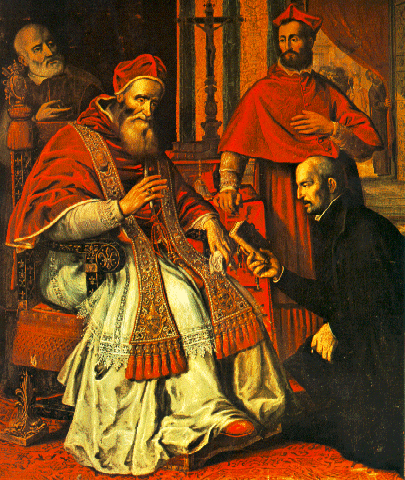
           More than a thousand years later St. Ignatius of Loyola is even more explicit in the Spiritual Exercises when he lists the rules “to have the true sentiment which we ought to have in the Church Militant”:  


Pope Paul III and St. Ignatius Loyola


To be right in everything, we ought always to hold that the white which I see, is black, if the Hierarchical Church so decides it, believing that between Christ our Lord, the Bridegroom, and the Church, His Bride, there is the same Spirit see which governs and directs us for the salvation of our souls. Because by the same Spirit and our Lord Who gave the ten Commandments, our holy Mother the Church is directed and governed.
                          
    St. Ignatius is not urging that Catholics leave their brain behind when they enter the Church: notice that he does not refer simply to white, but "the white which I see".  In other words, when it comes to fundamental categories (i.e., right and wrong), we need to trust the Church's judgment over our own, because she has been promised the guidance of the Holy Spirit, while we, as individuals, have not.


Every Man A Pope

    It really could not be any other way.  If we make ourselves the ultimate arbiters of truth instead of deferring to the Church, then the individual believer becomes, in effect, infallible, his or her own Pope, the result of which could only be thousands upon thousands of little schisms; any sort of real communion becomes impossible.  In fact, that is exactly what we see among our separated brethren in the Protestant communities, whose separate denominations are now said to number in the tens of thousands, less than five hundred years after Luther nailed his ninety-five theses to the church door in Wittenberg.
    In the end, faith itself becomes an impossibility, if there is no Truth greater than my own personal "truth".  And if I’m the supreme judge, why do I need a church to teach me anything? For that matter, what use is religion at all, or a Divine Savior, if it’s up to me to determine whether there’s any sin from which to save me? Isn’t that the logical end-point of the Hermeneutic of Suspicion?  Just myself, closed in upon myself. That’s an awfully cold, lonely way to spend eternity; it brings to mind what St. Paul says: “Wretched man that I am! Who will deliver me from this body of death?” (Romans 7:24).  Paul, of course, knows the answer: “Thanks be to God through Jesus Christ our Lord!” (Romans 7:25).  Only Christ can save me from myself, I myself who “do not do the good I want, but the evil I do not want” (Romans 7:19).  This same Christ has given His Church the power to bind and loose (Matthew 18:18); who am I, or any of us, to be its judge?