Monday, October 12, 2015

What Is A "Hermeneutic Of Suspicion", And Why Does It Matter?

What The Heck Is Hermeneutics?  

Back in my undergraduate days my roommate took a class called "Hermeneutics." Not surprisingly, I felt compelled to ask, "What the heck is hermeneutics?" He explained that the word comes from the Greek word ἑρμηνεύω (hermeneuo) "to interpret", and is related to the name of the god Hermes, bringer and interpreter of dreams. Hermeneutics, then, means interpretation, and when we speak of a hermeneutic, we mean a framework through which one interprets raw information.  Even if we don't know the term, we all know the concept: if we say someone "sees the world through rose colored glasses", for instance, we mean that they employ a "hermeneutic of optimism"; if you refer to another person as being "always under a dark cloud", they have a "hermeneutic of pessimism".  If we want a somewhat more sophisticated example, someone who uses a Marxist hermeneutic interprets everything through to the lens of Class Struggle.

Hermes the Interpreter
    For most of us it seems a pretty esoteric word, and even if it's a part of our working vocabulary, it's probably not included in our everyday vocabulary.  Nonetheless, it's a handy term to have.  It gave Joseph Ratzinger (later Pope Benedict XVI), for instance, a very clear and precise way of summing up the the foundational error of both the "Spirit of Vatican II" progressives and the Lefebvrist ultra-traditionalists: both camps interpret the Second Vatican Council through a "hermeneutic of rupture", when the council should more properly be viewed through a "hermeneutic of continuity".  In other words, both groups operate with the assumption that Vatican II is a decisive break with the previous nineteen centuries of Catholic Tradition, the only difference being one group thinks that's a good thing, the other decidedly not.  Ratzinger was proposing that instead we should interpret the council with and through that Tradition.


The Hermeneutic of Suspicion

     A similar problem, one that can be found not only among die-hard progressives and rad trads, but also among many people who consider themselves "faithful Catholics, but . . ." (and in fact it's a temptation for all of us), is the "Hermeneutic of Suspicion". In other words, the default position that for any issue on which the Church takes a stance contrary to my preconceived ideas, political loyalties, the prevailing popular wisdom, or whatever else, She must convince me, beyond a shadow of a doubt, that my position is wrong and that her position is right.  This hermeneutic of suspicion is most conspicuously at play in the massive dissent from the traditional Catholic teaching on sexuality and family (which is not limited, by the way, to those who consider themselves "progressive").
    Am I saying that to be a good Catholic we need to stop thinking for ourselves, or "mindlessly" go along with the Church, as anti-Catholics are fond of telling us?  Not at all.   But nobody thinks and decides in a vacuum, we all need some basis for interpreting our world; "give me a place to stand", said Archimedes, "and I will move the world".  Being Catholic has always meant that we stand on the moral and metaphysical framework provided by Christ 's Church, and the Gospel as understood by that Church, not by the conventional wisdom or the prejudices of the cultural elite.


The Pillar and Foundation of Truth

    The demand that the Church must exhaustively prove to my satisfaction any teaching that does not correspond to my preferences before I believe, in fact,  seems to me to be the exact opposite of what has been normative for those who consider themselves faithful Catholics throughout the history of the Church.  St. Paul refers to “the church of the living God” as “the pillar and foundation of truth” (1 Tim. 3:15), and in another place he makes explicit where the believer is to stand in case of conflict between the Truth of God and the conventional wisdom:
           Let no one deceive himself. If any one among you considers himself wise in this age, let him become a fool so as to become wise.  For the wisdom of this world is foolishness in the eyes of God, for it is written: "He catches the wise in their own ruses," and again: "The Lord knows the thoughts of the wise, that they are vain."  (1 Cor. 3:18-20)
It was understood in the early Church as well, where the authority to make final and binding decisions lay.  St. Augustine once said:
For already two councils on this question have been sent to the apostolic see; and replies have also come from there.  The cause is finished [causa finita est]; would that the error might be sometime finished also! (Sermon 131:10)
The expression causa finita est  comes from the practice of law; the modern expression that most closely corresponds to causa finita est is “case closed!”  To Augustine it seems a given that the replies from Rome have ended the discussion.
           More than a thousand years later St. Ignatius of Loyola is even more explicit in the Spiritual Exercises when he lists the rules “to have the true sentiment which we ought to have in the Church Militant”:  
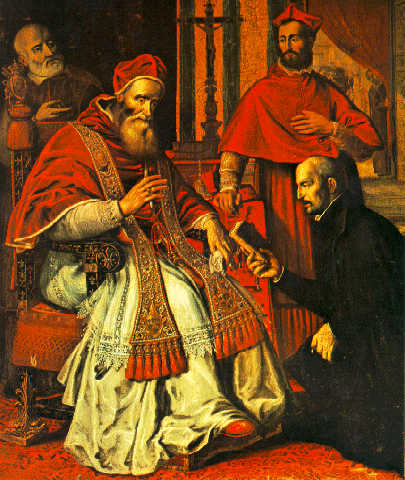

Pope Paul III and St. Ignatius Loyola


To be right in everything, we ought always to hold that the white which I see, is black, if the Hierarchical Church so decides it, believing that between Christ our Lord, the Bridegroom, and the Church, His Bride, there is the same Spirit see which governs and directs us for the salvation of our souls. Because by the same Spirit and our Lord Who gave the ten Commandments, our holy Mother the Church is directed and governed.
                          
    St. Ignatius is not urging that Catholics leave their brain behind when they enter the Church: notice that he does not refer simply to white, but "the white which I see".  In other words, when it comes to fundamental categories (i.e., right and wrong), we need to trust the Church's judgment over our own, because she has been promised the guidance of the Holy Spirit, while we, as individuals, have not.


Every Man A Pope

    It really could not be any other way.  If we make ourselves the ultimate arbiters of truth instead of deferring to the Church, then the individual believer becomes, in effect, infallible, his or her own Pope, the result of which could only be thousands upon thousands of little schisms; any sort of real communion becomes impossible.  In fact, that is exactly what we see among our separated brethren in the Protestant communities, whose separate denominations are now said to number in the tens of thousands, less than five hundred years after Luther nailed his ninety-five theses to the church door in Wittenberg.
    In the end, faith itself becomes an impossibility, if there is no Truth greater than my own personal "truth".  And if I’m the supreme judge, why do I need a church to teach me anything? For that matter, what use is religion at all, or a Divine Savior, if it’s up to me to determine whether there’s any sin from which to save me? Isn’t that the logical end-point of the Hermeneutic of Suspicion?  Just myself, closed in upon myself. That’s an awfully cold, lonely way to spend eternity; it brings to mind what St. Paul says: “Wretched man that I am! Who will deliver me from this body of death?” (Romans 7:24).  Paul, of course, knows the answer: “Thanks be to God through Jesus Christ our Lord!” (Romans 7:25).  Only Christ can save me from myself, I myself who “do not do the good I want, but the evil I do not want” (Romans 7:19).  This same Christ has given His Church the power to bind and loose (Matthew 18:18); who am I, or any of us, to be its judge?

Saturday, October 10, 2015

"Feed The Birds" - Mary Poppins & The Synod On The Family

I just love the song "Feed The Birds", a beautiful little paean to compassion from the movie Mary Poppins:

All around the Cathedral the Saints and Apostles
Look down as she sells her wares
Although you can't see it, you know that they're smiling
Each time someone shows that he cares

It's evident, I think, that it's compassion for the "little old bird woman" herself, and not merely for the birds, that brings joy to the Saints and Apostles.
     Below I also provide a few thoughts on why the Bishops gathered in the Synod on the Family would do well to watch Mary Poppins before they do anything else.


     I think it could only help if the bishops assembled in Rome for the Synod on the Family took a couple hours off to watch the movie Mary Poppins.  Since they seem interested in talking about everything but "The Family", taking a little film break can't hurt, but more than that, they need to see this movie.
     I say this, by the way, as someone who is decidedly not a Disney fan.  My children saw few Disney movies growing up, none more than once, except this one.  Sure, it has it's flaws (not the least of which is Dick Van Dyke's atrocious attempt at a cockney accent), and it's share of Disney goofiness, but there's something beautiful about it.  At the beginning, the family is falling apart, and moving in opposite directions: the father, Mr. Banks, is so caught up in his career that barely notices his surroundings, including his wife and children; Mrs. Banks devotes most of her attention to political advocacy, and the neglected children, Jane and Michael, respond by running wild and tormenting the governesses to whom the parents leave the task of "molding" their "breed".  That is, until Mary Poppins becomes their new governess.


Jane Darwell as the bird woman in Mary Poppins
     Much of the fun in the film comes the magical adventures the children experience in the company of Mary Poppins: jumping into sidewalk drawings, visiting a house where laughing causes them to float up to the ceiling (and where they can only come back to earth by thinking sad thoughts), flying up through the chimney and dancing on the London rooftops, and so on.  The most magical thing Mary Poppins does, however, is to bring the divided family back together . . . and then take herself out of the picture, sacrificing her own feelings so she won't come between them.  The movie ends with Parents and Children united in love, and Mary Poppins, the catalyst, quietly moving on to her next assignment.
     It certainly couldn't hurt the Synod Fathers to take a little break from their deliberations, where, if we can trust the news reports, they seem to be paying little attention to anything that could reunite the family.  After the film, they might want to take a look at the Book of Malachi, whose closing verse starts with the same theme we see at the end of Mary Poppins :

And he will turn the hearts of fathers to their children and the hearts of children to their fathers (Malachi 4:6)

But that's not the end; the second half of the verse, the final words in the Old Testament, leave us with a warning:

lest I come and smite the land with a curse.

Let us please pray that the Lord grant our shepherds the wisdom to heed His Word.

Friday, October 9, 2015

Dionysius the Areopagite: a Believer Among The Sceptics


Icon of Dionysius the Areopagite
Today (October 9th) is the feast day of Dionysius the Areopagite.  We know very little for certain about this Saint, who is often confused with St. Dionysius of Paris (St. Denis), Patron of France, and also with a mystical writer living half a millennium later known as the Pseudo-Dionysius.  We do know that today’s Saint was among a handful of listeners converted by St. Paul when he spoke in Athens (Acts 17:16-34).  The title “Areopagite” which Luke gives him suggests that he was one of the legal scholars or philosophers who frequented the Athenian assembly place known as the Areopagus (Hill of Mars), which is where he heard St. Paul speak.  
    As such he was an unlikely convert, and the fact that he heard St. Paul at all was the result of a string of (seemingly) random events.  As Luke tells it in Acts, Paul doesn’t seem to have intended to go to Athens at all: he went there fleeing from hostile crowds in Thessalonika and Beroea.  Once he was there, the Apostle went about doing what he usually did:


Now while Paul was waiting for them at Athens, his spirit was provoked within him as he saw that the city was full of idols. So he argued in the synagogue with the Jews and the devout persons, and in the market place every day with those who chanced to be there. (Acts 17:16-17)


Athens being Athens, there were some who took a professional interest in what St. Paul had to say:


Some also of the Epicurean and Stoic philosophers met him. And some said, "What would this babbler say?" Others said, "He seems to be a preacher of foreign divinities"--because he preached Jesus and the resurrection. And they took hold of him and brought him to the Areopagus, saying, "May we know what this new teaching is which you present? For you bring some strange things to our ears; we wish to know therefore what these things mean." (Acts 17:18-20)


    The traditional designation of what comes next as the “Sermon on the Areopagus” can be misleading.  The greek word translated “took hold of him”, ἐπιλαβόμενοι, comes from a word that means to “seize” or “arrest”. Paul was not so much invited to come share his views as he was brought in for questioning.  However he got there, he saw an opportunity to evangelize, and he made the most of it.  Like any good teacher, he starts out with some praise to put his audience in a receptive frame of mind:


"Men of Athens, I perceive that in every way you are very religious.” (Acts 17:22)


He quickly uses this opening to bring them in the direction he wants to go, using their own religious observance to introduce Jesus Christ:


For as I passed along, and observed the objects of your worship, I found also an altar with this inscription, 'To an unknown god.' What therefore you worship as unknown, this I proclaim to you (Acts 17:23).


He goes on to tell the Athenians that this God who is “unknown” no longer is the Creator of the Universe and, in contrast to the Olympian gods of the Greeks, is completely apart from and beyond His creation; that he has made us to seek him out; that we are fashioned in his image, as opposed to pagan idols that we model after ourselves; that he forgives our previous worship of these false divinities because we knew no better, but now that the full truth has been revealed, we will be held responsible, and that he has given us a sign of all these things by raising Jesus Christ from the dead (Acts 17:24-31).

St. Paul On The Areopagus, by Mariano Fortuny


    This last point proves to be a little too much for some of his listeners, who “mocked” when “they heard of the resurrection of the dead” (Acts 17:32); others seemed at least to keep an open mind, saying "We will hear you again about this"(Acts 17:32).  A small number went further:


But some men joined him and believed, among them Dionysius the Areopagite and a woman named Damaris and others with them (Acts 17:34).


A small beginning, it seems, but Jesus tells us in another place in Scripture that small beginnings often lead to something much greater:


"The kingdom of heaven is like a grain of mustard seed which a man took and sowed in his field; it is the smallest of all seeds, but when it has grown it is the greatest of shrubs and becomes a tree, so that the birds of the air come and make nests in its branches." (Matthew 13:31-32)


    It’s not difficult to see in the learned sceptics of the Areopagus the forerunners of today’s cultural leaders and opinion makers.  As we saw above, St. Paul finds a way to respect his listeners without watering down his own message, even when most of them seem to reject the Good News, just like those in John’s Gospel who say “This is a hard saying.  Who can listen to it?” (John 6:60).  And just as Jesus allows those doubting disciples to walk away, Paul doesn’t try to change his message to win back the scoffers.  And of course not all of them turn a deaf ear: Dionysius, Demaris, and a few others will be the seed of a much greater Christian community in Athens.
    The spirit of our age would probably look familiar to the crowd on Athens’ Mars Hill, an age sceptical of everything except its own cleverness.  We can take heart from St. Paul’s boldness in proclaiming the Gospel and St. Dionysius’s courage in the face of the hostility or indifference of his peers.  May God grant us all their steadfast Faith.

Thursday, October 8, 2015

Truth Is On The Side Of Life

“We need not resolve the difficult question of when life begins.”  Thus spake Justice Blackmun, writing for the majority in the U.S, Supreme Court’s Roe vs. Wade decision in January, 1973.  And so the era of virtually unlimited abortion in the United States burst upon the nation in a flurry of obfuscation and falsehood.  There never was, in fact, any question of when “life begins”, certainly not on scientific grounds (I defy you to find a biology text that does not agree that life begins at conception): the only question was whether all human life was deserving of protection, or only certain lives.  For more than four decades now, the abortion industry and its apologists have relied on verbal smokescreens like Justice Blackmun’s to provide just enough cover that Americans can avoid the ugly truth about abortion.


     It’s getting harder all the time to keep the charade going.  In 1973, ultrasound was not yet commonly used by obstetricians in the United States, and so for the vast majority of Americans unborn babies remained invisible, out-of-sight . . . and therefore fairly easy to dismiss.  Not anymore.  Virtually all expectant mothers have pictures of their babies in the womb long before the birth, pictures that have become increasingly clearer and more life-like.  If it looks like a baby, squirms like a baby, gives a “thumbs up” like a baby (see photo above), well, what can one conclude?  Of course, women who go to abortion clinics are unlikely to be offered such pictures, even if an ultrasound is performed, because women who see an ultrasound of their unborn baby are much less likely to abort (see here).
      Howard Slugh, an attorney, addresses the ultrasound issue in an article [here] in National Review Online called “The Life-Affirming Power of Ultrasound”.  He discusses in particular the growing number of state laws in the U.S. that require the abortionist to perform an ultrasound and to show the images to the mother of the unborn baby.  There are some interesting features to the legal battles over these laws.  First of all, even though abortionists deny that ultrasounds change minds, they “in fact have conceded the point in lawsuits challenging mandatory ultrasound laws”, which they have been fighting tooth-and-nail to stop.
     That’s not the only revealing thing about the abortionists’ legal arguments.  “No one” Slugh tells us, “asserts that the images are misleading or that the laws require additional pro-life commentary.”  The abortion providers can only argue that simply requiring them to show truthful, unaltered pictures of what (which is really, as the images show, who) is being aborted will dissuade some of their customers.  A federal court, in striking down one of these laws in North Carolina, said in its decision that the law “explicitly promotes a pro-life message by demanding the provision of facts that all fall on one side of the abortion debate.”  Notice that the law does not require the suppression of “facts” that fall on the other side of the debate: it simply requires that the mother know all the facts before undergoing abortion, and the facts happen to be pro-life.  And so the abortionists are reduced to asking the court to help them hide the truth.  As Slugh notes:

All these sources agree that the more a mother knows about her child, the less likely she is to abort him.  This is not because ultrasound images are misleading or politicized; it is because they supply a mother with truthful information necessary for making an informed choice.


It’s good to bear this in mind as we work to protect life: truth is our ally.  We should continue to publicize the truth by educating and informing our fellow citizems, by participating in pro-life events, and by supporting pro-life laws such as the ones mentioned above that give women more access to full and accurate information. But more than that, we should also be sure to pray to the Lord of Truth, that He continue to open our eyes and hearts, and those of our fellow people, to the Truth of the humanity of the unborn, and to the sanctity of all human life.


Wednesday, October 7, 2015

Teenage Werewolves And Other Mythical Beasts

(This Worth Revisiting post was first published on May 13th, 2014. To enjoy the work of other faithful Catholic bloggers see Worth Revisiting Wednesday, hosted by Elizabeth Reardon at theologyisaverb.com and Allison Gingras at reconciledtoyou.com.)


Enter The Teenager   

        We tend to take the environment in which we live for granted, to unthinkingly assume that the way things are now is how they are always supposed to be. For instance, I was born just a couple of weeks before the Cuban Missile crisis, and grew to adulthood in a world overshadowed by the Cold War and a seemingly intractable rivalry between the West and the Communist Bloc.  Those of a certain age will identify with my sense of amazement when the apparently permanent Communist Bloc simply vanished in the space of a few short years.  Our tendency to think of the contours of the world we know as fixed and eternal can blind us both to current problems and to future possibilities, but even worse than that: as Catholics we should know that the things that really are fixed and eternal are beyond this world, and they alone give us the context in which to consider worldly things in their true perspective.   

      Consider, for instance, the curious creature we know as "The Teenager", a term that does not simply mean an adolescent (with all the interesting quirks that go along with that stage of development), but a distinct "identity" with its own Teen Culture.  Some years ago I read an article by Thomas Hine called “The Rise And Decline of the Teenager” (here) that crystallized for me something that I should already have known from studying history: that our understanding of the teenager, and what it means to be one, even that there is such a creature, is a very recent product of our historical circumstances.  Hine says:

Most adults seem to view this conflicted, contradictory figure of the teenager as inevitable, part of the growth of a human being.  Yet many people now living [in 1999] came of age before there was anything called a teenager.

A Failed Adolescent

     Hines writes from a secular perspective, and I don’t go along with all of his conclusions, but there is quite a lot of valuable information in his essay.  He traces the birth of “the teenager” back to the Great Depression (the word first appears in print in 1941 in Popular Science magazine), when for the first time a majority of adolescent Americans were actually enrolled in high school; previously, most young men at this age would already be working full time, and most young women would have been married or working in their parents’ home.  The teenager, as Hines plausibly tells the tale, is largely the product of universal (mostly public) high school attendance.
     The article is more concerned with the development of teenagerdom than with exploring its ramifications (he may do more analysis in his books and on his website, which I have not explored), but he does offer some interesting insights.  For instance:

Indeed, the teenager may be, as Edgar Z. Friedenberg argued in a 1959 book, a failed adolescent. Being a teenager is, he said, a false identity, meant to short-circuit the quest for a real one. By giving people superficial roles to play, advertising, the mass media, and even the schools confuse young people and leave them dissatisfied and thus open to sales pitches that promise a deepening of identity.

The word "adolescent" means "becoming an adult", but teenhood is presented to young people as a destination in itself, directing adolescents away from their true mission of preparing to take their place in the grown-up world (hence the "failure"). Hines goes on to say:

We stopped expecting young people to be productive members of society and began to think of them as gullible consumers.  We denned maturity primarily in terms being permitted adult vices, and then were surprised when teenagers drank, smoked, or had promiscuous sex.


Boys To Men?

     There is a lot to think about here.  While there are and have been certain natural features of adolescence, such as impulsiveness, emotionalism, and (dare I say it) a certain arrogance, the idea of a “youth culture”, distinct from (or even in rebellion against) the adult culture is a new and, I would argue, destructive phenomenon. Adolescent males in particular had traditionally exhibited their youthful “spiritedness” in an impatience to join their fathers and participate in the World of Adult Men. Their eagerness to enter this august company, to take on the “identity” of a grown man, was their impetus to integrate productively with the rest of their society. Its markers were not just work, but marriage and fatherhood, and therefore taking on responsibility was the public proof of Manhood.  Now, as Hines points out, the young are encouraged to see adulthood as a time to give free rein to the sort of self-indulgent irresponsibility that is so attractive to adolescents.  One might add that the near-universality of college attendance seems to be extending Teenhood even further into adulthood, with the result that we are seeing ever more Perpetual Teens.


What Are They Teaching in These Schools?

Michael Landon in the film I Was A Teenage Werewolf
     It seems clear to me that we don’t want our adolescent children to self-identify with the secular “youth culture.” When I first read this article our oldest child had just turned three, and we had already decided to teach him and his siblings at home.  We were primarily concerned with the formation of character and instruction in the Faith, and homeschooling seemed the best way to avoid the pitfalls of the teenage peer culture.  At the same time I understand that homeschooling is not going to be the answer for many, probably most, Catholic families. Good Catholic schools are a much better option than the public schools (not all Catholic schools are “good” ones, unfortunately), especially schools that take the faith seriously.  In the best Catholic schools you won’t find sexual morality being taught by Planned Parenthood, there will be less left-wing indoctrination (much will depend, of course,  on individual teachers) and the Catholic faith will not only be taught, but be a living reality in the school.

     On the other hand, any institutional school, however good, will inevitably contribute to some of the negative outcomes noted above. I’m not saying this to discourage anyone; I have taught full-time in Catholic schools for the past twenty-nine years, and I would have quit long ago if I didn’t think they were, on balance, a good thing. Nonetheless, there will be a powerful attraction to the peer culture, and many, probably most, of your sons’ and daughters’ classmates will have been influenced much more by secular values and the consumer culture than by traditional Christian belief and practice. 

Parents Are The Primary Educators

     Whether we send our children to Catholic school or teach them at home, we are their primary educators, and God has given us parents, not the schools (and certainly not the popular culture) the graces to direct their formation properly (see St. John Paul II's Letter to Families).  If we do send our sons and daughters to school we need to make an extra effort to help them form their identity as members of the Mystical Body of Christ, of their family, and of society, not their peer group. One way is to see that they are involved in activities outside of school that involve people of different ages.  For example, when my sons were younger we took part in a Catholic ConQuest group with a lot of boys of different ages, but also a number of fathers who not only directed activities but also participated along with their sons, the adult men acting as guides and role models for the boys.  Also, however good the religious instruction may be at the school, it’s not sufficient; the parents must take a direct role in the instruction of their children and offer an example of living a Christ-centered life (and it’s vitally important for fathers to be the high-priest of the domestic church: see here).  If we who are concerned for the well-being and eternal salvation of our children don’t take the lead, then the secular culture, which cares for neither of those things, will step in.

     Too often I have seen parents throw up their hands in the belief that there is nothing they can do.  But there is: teenagerhood, unlike biological sex, is not an immutable fact.  At the age when young men and women should be well along in the task of conforming themselves to the responsibilities of adulthood, it is unhealthy for them and corrosive of a healthy society to be accustoming themselves greater irresponsibility and self-indulgence. While each of us all must go through his or her teens, none needs to be a Teenager.

Tuesday, October 6, 2015

Abortion Myth #2

MYTH: "Abortion is safer than childbirth."

TRUTH:

- A government funded study in Finland in 1997 found that women were four times more likely to die in the year following an abortion than in the year following childbirth.  More recent studies in Canada and California reached similar conclusions.

- Since the 1950’s dozens of studies around the world have shown a significantly greater risk of breast cancer for women who have had abortions.

- Women who have had abortions are also at greater risk of cervical, ovarian, and liver cancer.

-Women who have had abortions are at higher risk of complications in subsequent pregnancies, including: complications of labor, placenta previa, ectopic pregnancy and handicapped newborns.

-10% of women undergoing elective abortion will suffer immediate complications, of which approximately one fifth (2%) are considered life threatening.

-Women still die every year from legal abortions (see Gosnell, Kermit [link]).

(figures courtesy of the Elliot Institute, www.afterabortion.org)


DON’T BUY THE LIE!


Essential Pro-Life Resources:

Pro-Life Answers to Pro-Choice Arguments (link)  

The Elliot Institute (link)  

National Right To Life Committee (link)  

Care-Net (link)

The Nurturing Network (link)

To See The Entire Abortion Myths Series Click HERE 

Sunday, October 4, 2015

"O God Beyond All Praising" - From Pope Francis's U.S. Visit

Pope Francis leading Vespers service at St. Patrick's Cathedral in New York
    I have to confess that I'm not a big fan of the early twentieth century English composer Gustav Holst.  It's not that he wasn't a gifted composer; it's just that his music, for the most part, is a little too angular for my tastes (as is the case with other composers of his era as well).  His most famous work, for instance, The Planets, has some very moving passages, and some that can even be called brilliant, but little I would consider really beautiful . . . except for one soaring, melodic passage that shines out from the “Jupiter” movement.  Holst later set this tune to the words of a patriotic poem called “I Vow To Thee My Country”; the hymnist Ralph Vaughn Williams (a friend of the composer) shortly thereafter included his setting of the melody in a volume of church music. It has since provided the musical background for a large number of Christian hymns.
    One of the better known of these, “O God Beyond All Praising” with words by Michael Perry,  has become one of my favorite hymns.  Here it is the closing song of a Vespers service with Pope Francis last weekend in New York.   I have had a hard time finding a good Catholic performance of this hymn on YouTube, and the sound quality on this one isn’t the best, but it certainly seems to be Catholic.
    One of the ironies of this tune, by the way, is that Holst’s inspiration for The Planets was not astronomy, but astrology: this tune was supposed to represent the “joviality” to be found under the Sign of Jupiter.  How wonderful that when people hear it today, it is instead almost always as a song of praise to the True God and Creator of the Universe.

Thursday, October 1, 2015

St. Therese of Lisieux, Spiritual Warrior

   What can one say about St. Therese of Lisieux?  I almost didn’t say anything, expecting that the blogosphere would be filled with an abundance of inspiring and insightful commentary on this wonderful Saint, an expectation that has not been disappointed.  St. Therese, however, has a way of getting what she wants, and she is very reluctant to take "no" for an answer (just ask Leo XIII), so who am I to refuse?  I can at least add a brief comment or two to the (well-deserved) tributes to The Little Flower.
     One thing that strikes me is how well St. Therese complements St. Ignatius of Loyola, whom I have been discussing with my adolescent Theology students.  St. Ignatius urges us to “Find God in All Things”, which is one of the major themes of his Spiritual Exercises and Ignatian Spirituality in general.  St. Therese, it seems to me, takes that a step further and asks us to then serve God in all things.  That is the essence of her Little Way: we can do even something as (apparently) trivial as, say, sweeping the floor “For The Greater Glory of God” (Ad Maiorem Dei Gloriam, or AMDG, a favorite motto of St. Ignatius and the Jesuits).
     It is in this way that St. Therese is a soldier.  Not a literal soldier, of course, as St. Ignatius had been; rather, with her Little Way she is a strategist, a general, for each one of us in the Spiritual War that rages in our heart and mind between the Spirit of Christ and the Spirit of Satan.  The Devil is in the details; inattention in little things can lead to self-centeredness in little things and, given just how many little things there are, can mean a lot of time focused on ourselves.  Self-immersion leads to selfishness, which is an invitation to the Evil One to move in.  It’s best not to yield an inch of ground to the Enemy and, as The Little Flower has shown us, save it all for Jesus.  Perhaps then, God willing, we can, like St. Therese, spend our Heaven doing Good.


What's Latin Got To Do With It?


   Thus the Roman tongue is now first and foremost a sacred tongue, which resounds in the Sacred Liturgy, the halls of divinity, and the documents of the Apostolic See.  In this same tongue you yourselves again and again address a sweet salutation to the Queen of Heaven, your Mother, and to your Father who reigns on high.  This tongue is the key that unlocks for you the sources of history.  Nearly all the Roman and Christian past preserved for us, in inscriptions, writings and books, with some exceptions of later centuries, wears the vesture of the Latin tongue.
 - His Holiness Pope Pius XII's Address to the Student Youth of Rome, January 30, 1949   

     Over the last couple of days I have been watching two gentlemen going back in forth in the comboxes about the Pope’s decision not to use Latin as the official language of the upcoming Synod of Bishops.  They both make some interesting points about the place and importance of the Latin language in the life of the Church. Their spirited discussion has got me thinking not just about Latin, but about some of the distinctive features of Catholicism. 


The Pagan Roman Vergil guides the Christian Dante on his way to Paradise


A God of the Particulars . . .

     Don’t get me wrong, I have some definite opinions about Latin (after all, teaching it has been my main source of income for the past three decades), both in general and in a Church context, but I’d like to use the discussion of the language as a springboard to a broader topic.  And, really, it’s something of a paradox.  I agree with Chesterton when he says: “It [Catholicism] is the only thing that frees a man from the degrading slavery of being a child of his age.”  Catholicism gives us an allegiance that is infinitely larger than those other things that try to make a claim on us, such as political parties and ideologies, nations, athletic teams and any number of false gods, including The Conventional Wisdom; and it is not just something larger, but something truer, something that is infinitely true, because it is our connection to the Infinite Omnipotent Creator.  At the same time, one of its unique features among the world’s religions is its interest in particulars, following the lead of its Lord, of whom I wrote in another post:

. . . He is a God of particulars.  He chose a particular people to whom he first revealed himself in order that he might incarnate himself among them in the person of the God-Man Jesus of Nazareth; he carefully chose and prepared Mary as the human mother of Jesus; he likewise chose and prepared particular individuals such as Peter and Paul to carry forward the mission of Jesus.

The Church has carefully preserved, in Scripture, in creeds, and in the broader tradition these names and the names of many others: and not only Saints, but Sinners such as the various Herods and Pontius Pilate.  The Gospels usually don’t simply tell us that Jesus entered a town, but that he entered, say, Tiberias, or Betheny.  We are told about real, individual men and women in well-known places that you can see, where you can walk down the same streets.  And it doesn’t end with Biblical figures and events: the Catholic Church has carefully preserved not only the names and stories of thousands of Saints over the past two millennia, but actual pieces of their bodies as tokens that they were real people, not myths or abstractions. 

. . . And Yet Universal

     It may seem like a contradiction that Catholicism is at the same time the only truly Universal Religion and one uniquely focused on individual people and concrete things. But the living center of it all is the Incarnation, where the Second Person of the Trinity, the Eternal Word, becomes the Man Jesus of Nazareth: Infinite God in a finite body.  It is the glorified body of the Risen Christ that I find most telling here, particularly the passage where Jesus shows himself to the “doubting” Apostle Thomas: 

St. Thomas examining the wounds of Christ

Then he said to Thomas, “Put your finger here, and see my hands; and put out your hand, and place it in my side; do not be faithless, but believing.” Thomas answered him, “My Lord and my God!” (John 20:27-28) 

Who would have expected the Glorified Body, the eternal perfected Body, to include the horrible wounds inflicted on the first body here on Earth?  
     It seems to me that the Church, Christ’s Mystical Body on Earth, follows the model of the Master in incorporating into itself many of those things that happen to it along the way.  As St. Paul says:
  
We know that in everything God works for good with those who love him, who are called according to his purpose. (Romans 8:28) 

I’m not saying that the various experiences and traditions (including liturgical languages) that have been part of the history of the Church enjoy the same status as Christ’s Wounds. Rather, in the passage about Thomas we see a supreme example of a pattern that is reflected in lesser things as well. It does seem that God doesn’t want anything to go to waste, and that He can use those things to join us more closely to Himself and to each other.  Just look at how the stories of the Saints, from the very earliest days of the Church, have been incorporated into her liturgical life, and how devotion to them has brought countless Catholics closer to their Lord.  The same can be said of many devotional practices. 

What’s Latin Got to Do With It?

     This is where the discussion of Latin comes in.  It’s true that it wasn’t the first liturgical language of the Church (and for much of the Church never has been).  In the Western Church, however, the Latin Church, it replaced Greek within the first few centuries, when there was still a Roman Empire.  For the past fifteen centuries Latin was the language in which great theologians (St. Augustine, St. Thomas) formulated their thoughts, and the medium through which Catholics, including most of the greatest Saints, prayed to their God and heard His Word.  
St. Augustine of Hippo, last of the Romans
     That common language, on a purely human level, is a tangible way that we share in their experience.  I often relate to people, when discussing the study of Latin in a purely secular context, my experience studying English as a graduate student.  I found that in the work of authors writing in English prior to the mid-twentieth there always seemed to be a sort of substrata of allusions and knowing nods to the literary tradition of the Greeks and Romans, and a rich admixture of Latinisms; most of this was invisible to the vast majority of students who had never studied Latin (never mind Greek) or classical literature.  There was an entire dimension to the literature they were reading that they simply missed.  Consider how much more profound a loss that is in the context of the Church, whose traditions an institutions go back to a time before any language we could call English existed.   
     Of course, the Church is not merely an institution, and our predecessors in the faith are not merely our forebears: they are our fellow Christians, participants right now from their eternal heavenly home in the same Church, which is the Mysticum Corpus of Christ our Lord. If we venerate bits of their bone and tiny snips of their clothing, surely we must derive some spiritual benefit from praying the same prayers, not just the same thoughts but the exact same words, and singing the same songs as they did?  We are both body and soul, and we need tangible things to help us understand spiritual realities.  We can’t survive on abstractions: that’s why Our Lord has given us Sacraments.  The Latin language has been one of those tangible things for most of the history of the Western Church, one of the most prominent of those things (sociologists call them “identity markers”) that help us understand who we are and with whom we belong.

Look Before Leaping


     As I said above, this is not merely about Latin, because the gentleman is correct who said that the Church has changed her liturgical language in the past, and may do so again.  No human language is essential for Salvation, and the Church will go on with or without it (Matthew 16:18); also, she continually needs to assess whether the things she has picked up on the on the way are really helpful for her mission (Ecclesia reformans et semper reformanda, if I may indulge in an antique tongue). At the same time she must also consider long and hard before jettisoning things that have a long history of uniting those of us in the Church Militant with our predecessors who are now in the Church Triumphant, and beyond them to "Our Father who reigns on high," as Pope Pius XII reminds us.  Whatever happens in the upcoming Synod (things being what they are, it makes sense to conduct the proceedings in some other language), we would be unwise to abandon completely the Language of our Fathers (Lingua Patrum) too quickly.

(This Throwback was first published in January of this year.)