Showing posts with label law. Show all posts

Monday, February 8, 2016

Life Sells Chips (or, Chips Sell Life)

If you want to sell something, what better place than the most-watched television program of the year?  That, as those who follow American football or American pop culture could tell you, would be the Super Bowl, the National Football League’s annual championship game. Small wonder that advertisers spend millions of dollars for a single 30 second ad during the broadcast. Most often these ads are for things like beer, cell phones, cars, insurance, etc., but sometimes something a little different shows up.  Six years ago, for instance, Focus on the Family ran a pro-life ad featuring the mother of college football star Tim Tebow, which created a lot of discussion about the cause of life and, as I detailed in this post last week, saved at least one life.

Freddy Carstairs appearing in Doritos Super Bowl Ad (image from youTube)

    A Super Bowl ad promoting human life made waves again last night . . . but not in quite the same way as the Tebow ad did.  The commercial in question was advertising Doritos tortilla chips.  In this one, we see a mother happily looking at an ultrasound image of her late-stage unborn baby on a monitor; the mother then turns to her husband, who is contentedly munching on Doritos.  To the mother’s increasing annoyance, the father waves one of the salty snacks in front of the screen, where we can see the unborn baby reaching for the chip.  Finally, the exasperated mother grabs the chip from her husband’s hand and hurls it at her feet, at which point the unborn baby on the monitor, apparently eager to eat the chip, appears to dive for the “exit”, at which point the mother goes into labor.
    First of all, it’s a pretty sure bet that this ad is not intended (certainly not by Frito-Lay, the producer of Doritos) to make a pro-life statement.  According to an article that ran a couple weeks ago on lifesitenews.com, the creator of the ad, an Australian filmmaker named Peter Carstairs, came up with the idea when he saw ultrasound images of his unborn son Freddy (who was born last year). There is no indication that Carstairs was looking to make a pro-life statement; he did find the concept funny.  Frito-Lay chose Carstairs’ ad, no doubt because it tested well, and was unusual enough to stand out from the the welter of weird and ridiculous ads striving to make an impression upon Super Bowl viewers.

Ultrasound baby reaching for chip (image from Youtube)
    And make an impression it did, in some cases positive, in some . . . less so.  Apparently, NARAL PRo-Choice America (formerly the National Abortion Rights Action League) found this tortilla-affirming commercial to be guilty of the shameful “antichoice tactic of humanizing fetuses” (see article here), demonstrating yet again that pro-abortion fanatics cannot abide any suggestion that unborn humans are, well, human.  That’s why they insist on using dehumanizing terms like “fetus”.  That is also why they despise ultrasound, because sonograms make unavoidably obvious the already irrefutable scientific fact that unborn babies are not just “clumps of cells”, but little people.  Their objection to this particular commercial is not so much that the “fetus” is doing things that an unborn baby can’t do, but that the ultrasound image is being shown at all.  That’s why they fight tooth and nail against laws mandating that women seeking abortion first be shown an ultrasound of the “product of conception” in their womb: because ultrasound changes minds, even ordinary ultrasounds of unborn humans doing ordinary things.  As I detail in my post “The Truth Is Our Ally In The Fight For Human Life”:

    The abortion providers can only argue that simply requiring them to show truthful, unaltered pictures of what (or more accurately, as the images show, who) is being aborted will dissuade some of their customers.  A federal court, in striking down one of these laws in North Carolina, said in its decision [according to pro-life attorney Howard Slugh] that the law “explicitly promotes a pro-life message by demanding the provision of facts that all fall on one side of the abortion debate.”  Notice that the law does not require the suppression of “facts” that fall on the other side of the debate: it simply requires that the mother know all the facts before undergoing abortion, and the facts happen to be pro-life.  And so the abortionists are reduced to asking the court to help them hide the plain, incontrovertible truth.  As Slugh notes:

All these sources agree that the more a mother knows about her child, the less likely she is to abort him.  This is not because ultrasound images are misleading or politicized; it is because they supply a mother with truthful information necessary for making an informed choice.

Champion of Human Life?
    Last night’s silly little Doritos ad, has (most likely unintentionally) reminded millions of people about the truth of human life in the womb. I doubt that Frito-Lay was trying to make a pro-life statement with their ad: they probably saw it as just a funny take on an everyday experience that would help them sell chips.  It’s quite possible that, if they determine that the unfavorable attention from abortion promoters is hurting the bottom line, they may issue an apology and pull the ad from the internet (if YouTube doesn’t do it first).  Let’s hope not; we shouldn’t allow the abortion industry and its apologists to silence the Truth.  It might even be worth buying a bag of Doritos . . .   


Friday, January 22, 2016

Abortion Myth # 13

I'm re-posting "Abortion Myth # 13" today on the 43rd anniversary of the U.S. Supreme Court's Roe v. Wade and Doe v. Bolton decisions, which made abortion-on-demand the de facto law of the land.  Legal abortion is often presented by its supporters as necessary for women's rights; that claim doesn't stand up to scrutiny:


MYTH: "Legalized abortion is necessary for the protection of women’s rights."

TRUTH: Abortion demeans and exploits women.

-Pregnancy is a natural, healthy state for women; it is the most significant difference between women and men.  Treating pregnancy like a disease implies that there’s something wrong with the nature of women's bodies and therefore with simply being a woman.  The group Feminists for Life says in their Debate Handbook:

When women feel that a pregnant body is a body out of control, deviant, diseased, they are internalizing attitudes of low self-esteem toward the female body.  These attitudes contradict the rightful feminist affirmation of pregnancy as a natural bodily function which deserves societal respect and accommodation.

-It is also natural for women to want to protect and nurture their children; to destroy their own children when they are most in need of protection violates an essential part of women's nature.


Mother and Child, by Frederic Leighton

-Abortion denies the most basic right, the right to life, to hundreds of thousands of unborn women every year.

-Most women who abort do so because they believe they have no choice: many are coerced, and they are often abused and threatened with violence, with loss of employment or educational opportunities, or with other adverse consequences if they don’t abort (see http://www.theunchoice.com/coerced.htm ). Shouldn't we protect a woman's right not to be forced to kill her own children?

-Legalized abortion empowers irresponsible men, because it enables them to exploit women sexually without having to accept the responsibilities of fatherhood.

-Pro-abortion activists fight strenuously at every turn against laws requiring women be given information about abortion and its alternatives.  What about women's right to make informed choices?

-The original feminists (Susan B. Anthony, Elizabeth Cady Stanton, Alice Paul, for instance) opposed abortion on the grounds that abortion was a crime against women as well as their children.  Alice Paul said “Abortion is the ultimate exploitation of women.”

DON’T BUY THE LIE!


Essential Pro-Life Resources:

Pro-Life Answers to Pro-Choice Arguments (link)  

The Elliot Institute (link)  

National Right To Life Committee (link)  


Care-Net (link)

The Nurturing Network (link)


To See The Entire Abortion Myths Series Click HERE 

Friday, October 16, 2015

Abortion Myth # 3

MYTH: "There are few psychological consequences of abortion; most women simply feel relief."


TRUTH:

- A study of the medical records of 56,741 California medicaid patients revealed that women who had abortions were 160 percent more likely than delivering women to be hospitalized for psychiatric treatment in the first 90 days following abortion or delivery. Rates of psychiatric treatment remained significantly higher for at least four years. (link)


Approximately 60 percent of women who experience post-abortion sequelae report suicidal ideation, with 28 percent actually attempting suicide, of which half attempted suicide two or more times. (link)

-Over twenty studies have linked abortion to increased rates of drug and alcohol use. (link)

- Abortion is linked with increased depression, violent behavior, alcohol and drug abuse, replacement pregnancies, and reduced maternal bonding with children born subsequently. These factors are closely associated with child abuse and would appear to confirm individual clinical assessments linking post-abortion trauma with subsequent child abuse. (link)

- Post-abortion couples are more likely to divorce or separate. Many post-abortion women develop a greater difficulty forming lasting bonds with a male partner. (link)

- Women who have one abortion are at increased risk of having additional abortions in the future. Women with a prior abortion experience are four times more likely to abort a current pregnancy than those with no prior abortion history. (link)

- Some women experience all or some of the symptoms of post-traumatic stress disorder (PTSD). (link)


-Some claim that having the "products of conception" removed in an abortion is no more traumatic than having a tooth pulled.  Yet many thousands of women belong to postabortion support groups such as Silent No More, Women Exploited By Abortion, and  American Victims of Abortion, or seek healing from programs like  Project Rachel and Rachel’s Vineyard.  Why don’t survivors of other "common medical procedures" need support groups?

 To read the testimonies of women scarred by abortion, see Silent no More,Women Exploited By AbortionThe Elliot Institute

Another extensive resource on the documented psychological effects of abortion can be found here.

DON’T BUY THE LIE!

Essential Pro-Life Resources

Pro-Life Answers to Pro-Choice Arguments (link)  

The Elliot Institute (link)  

National Right To Life Committee (link)  

Care-Net (link)

The Nurturing Network (link)


To See The Entire Abortion Myths Series Click HERE

Monday, October 12, 2015

What Is A "Hermeneutic Of Suspicion", And Why Does It Matter?

What The Heck Is Hermeneutics?  

Back in my undergraduate days my roommate took a class called "Hermeneutics." Not surprisingly, I felt compelled to ask, "What the heck is hermeneutics?" He explained that the word comes from the Greek word ἑρμηνεύω (hermeneuo) "to interpret", and is related to the name of the god Hermes, bringer and interpreter of dreams. Hermeneutics, then, means interpretation, and when we speak of a hermeneutic, we mean a framework through which one interprets raw information.  Even if we don't know the term, we all know the concept: if we say someone "sees the world through rose colored glasses", for instance, we mean that they employ a "hermeneutic of optimism"; if you refer to another person as being "always under a dark cloud", they have a "hermeneutic of pessimism".  If we want a somewhat more sophisticated example, someone who uses a Marxist hermeneutic interprets everything through to the lens of Class Struggle.

Hermes the Interpreter
    For most of us it seems a pretty esoteric word, and even if it's a part of our working vocabulary, it's probably not included in our everyday vocabulary.  Nonetheless, it's a handy term to have.  It gave Joseph Ratzinger (later Pope Benedict XVI), for instance, a very clear and precise way of summing up the the foundational error of both the "Spirit of Vatican II" progressives and the Lefebvrist ultra-traditionalists: both camps interpret the Second Vatican Council through a "hermeneutic of rupture", when the council should more properly be viewed through a "hermeneutic of continuity".  In other words, both groups operate with the assumption that Vatican II is a decisive break with the previous nineteen centuries of Catholic Tradition, the only difference being one group thinks that's a good thing, the other decidedly not.  Ratzinger was proposing that instead we should interpret the council with and through that Tradition.


The Hermeneutic of Suspicion

     A similar problem, one that can be found not only among die-hard progressives and rad trads, but also among many people who consider themselves "faithful Catholics, but . . ." (and in fact it's a temptation for all of us), is the "Hermeneutic of Suspicion". In other words, the default position that for any issue on which the Church takes a stance contrary to my preconceived ideas, political loyalties, the prevailing popular wisdom, or whatever else, She must convince me, beyond a shadow of a doubt, that my position is wrong and that her position is right.  This hermeneutic of suspicion is most conspicuously at play in the massive dissent from the traditional Catholic teaching on sexuality and family (which is not limited, by the way, to those who consider themselves "progressive").
    Am I saying that to be a good Catholic we need to stop thinking for ourselves, or "mindlessly" go along with the Church, as anti-Catholics are fond of telling us?  Not at all.   But nobody thinks and decides in a vacuum, we all need some basis for interpreting our world; "give me a place to stand", said Archimedes, "and I will move the world".  Being Catholic has always meant that we stand on the moral and metaphysical framework provided by Christ 's Church, and the Gospel as understood by that Church, not by the conventional wisdom or the prejudices of the cultural elite.


The Pillar and Foundation of Truth

    The demand that the Church must exhaustively prove to my satisfaction any teaching that does not correspond to my preferences before I believe, in fact,  seems to me to be the exact opposite of what has been normative for those who consider themselves faithful Catholics throughout the history of the Church.  St. Paul refers to “the church of the living God” as “the pillar and foundation of truth” (1 Tim. 3:15), and in another place he makes explicit where the believer is to stand in case of conflict between the Truth of God and the conventional wisdom:
           Let no one deceive himself. If any one among you considers himself wise in this age, let him become a fool so as to become wise.  For the wisdom of this world is foolishness in the eyes of God, for it is written: "He catches the wise in their own ruses," and again: "The Lord knows the thoughts of the wise, that they are vain."  (1 Cor. 3:18-20)
It was understood in the early Church as well, where the authority to make final and binding decisions lay.  St. Augustine once said:
For already two councils on this question have been sent to the apostolic see; and replies have also come from there.  The cause is finished [causa finita est]; would that the error might be sometime finished also! (Sermon 131:10)
The expression causa finita est  comes from the practice of law; the modern expression that most closely corresponds to causa finita est is “case closed!”  To Augustine it seems a given that the replies from Rome have ended the discussion.
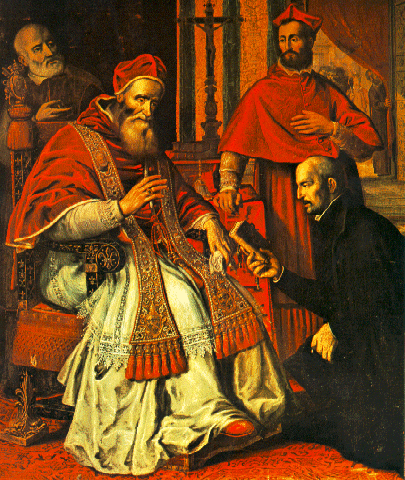
           More than a thousand years later St. Ignatius of Loyola is even more explicit in the Spiritual Exercises when he lists the rules “to have the true sentiment which we ought to have in the Church Militant”:  


Pope Paul III and St. Ignatius Loyola


To be right in everything, we ought always to hold that the white which I see, is black, if the Hierarchical Church so decides it, believing that between Christ our Lord, the Bridegroom, and the Church, His Bride, there is the same Spirit see which governs and directs us for the salvation of our souls. Because by the same Spirit and our Lord Who gave the ten Commandments, our holy Mother the Church is directed and governed.
                          
    St. Ignatius is not urging that Catholics leave their brain behind when they enter the Church: notice that he does not refer simply to white, but "the white which I see".  In other words, when it comes to fundamental categories (i.e., right and wrong), we need to trust the Church's judgment over our own, because she has been promised the guidance of the Holy Spirit, while we, as individuals, have not.


Every Man A Pope

    It really could not be any other way.  If we make ourselves the ultimate arbiters of truth instead of deferring to the Church, then the individual believer becomes, in effect, infallible, his or her own Pope, the result of which could only be thousands upon thousands of little schisms; any sort of real communion becomes impossible.  In fact, that is exactly what we see among our separated brethren in the Protestant communities, whose separate denominations are now said to number in the tens of thousands, less than five hundred years after Luther nailed his ninety-five theses to the church door in Wittenberg.
    In the end, faith itself becomes an impossibility, if there is no Truth greater than my own personal "truth".  And if I’m the supreme judge, why do I need a church to teach me anything? For that matter, what use is religion at all, or a Divine Savior, if it’s up to me to determine whether there’s any sin from which to save me? Isn’t that the logical end-point of the Hermeneutic of Suspicion?  Just myself, closed in upon myself. That’s an awfully cold, lonely way to spend eternity; it brings to mind what St. Paul says: “Wretched man that I am! Who will deliver me from this body of death?” (Romans 7:24).  Paul, of course, knows the answer: “Thanks be to God through Jesus Christ our Lord!” (Romans 7:25).  Only Christ can save me from myself, I myself who “do not do the good I want, but the evil I do not want” (Romans 7:19).  This same Christ has given His Church the power to bind and loose (Matthew 18:18); who am I, or any of us, to be its judge?

Thursday, September 24, 2015

Official Text of Pope Francis' Address To U.S. Congress

The official text of Pope Francis' address to the United States Congress on September 24th, 2015.

     Mr. Vice-President, Mr. Speaker, Honorable Members of Congress, Dear Friends,
I am most grateful for your invitation to address this Joint Session of Congress in “the land of the free and the home of the brave.” I would like to think that the reason for this is that I too am a son of this great continent, from which we have all received so much and toward which we share a common responsibility.

Pope Francis addressing  jU.S.  Congress (AP photo - Carolyn Kaster)

     Each son or daughter of a given country has a mission, a personal and social responsibility. Your own responsibility as members of Congress is to enable this country, by your legislative activity, to grow as a nation. You are the face of its people, their representatives. You are called to defend and preserve the dignity of your fellow citizens in the tireless and demanding pursuit of the common good, for this is the chief aim of all politics. A political society endures when it seeks, as a vocation, to satisfy common needs by stimulating the growth of all its members, especially those in situations of greater vulnerability or risk. Legislative activity is always based on care for the people. To this you have been invited, called and convened by those who elected you.
     Yours is a work which makes me reflect in two ways on the figure of Moses. On the one hand, the patriarch and lawgiver of the people of Israel symbolizes the need of peoples to keep alive their sense of unity by means of just legislation. On the other, the figure of Moses leads us directly to God and thus to the transcendent dignity of the human being. Moses provides us with a good synthesis of your work: you are asked to protect, by means of the law, the image and likeness fashioned by God on every human face.
     Today I would like not only to address you, but through you the entire people of the United States. Here, together with their representatives, I would like to take this opportunity to dialogue with the many thousands of men and women who strive each day to do an honest day’s work, to bring home their daily bread, to save money and –one step at a time – to build a better life for their families. These are men and women who are not concerned simply with paying their taxes, but in their own quiet way sustain the life of society. They generate solidarity by their actions, and they create organizations which offer a helping hand to those most in need.
I would also like to enter into dialogue with the many elderly persons who are a storehouse of wisdom forged by experience, and who seek in many ways, especially through volunteer work, to share their stories and their insights. I know that many of them are retired, but still active; they keep working to build up this land. I also want to dialogue with all those young people who are working to realize their great and noble aspirations, who are not led astray by facile proposals, and who face difficult situations, often as a result of immaturity on the part of many adults. I wish to dialogue with all of you, and I would like to do so through the historical memory of your people.
     My visit takes place at a time when men and women of good will are marking the anniversaries of several great Americans. The complexities of history and the reality of human weakness notwithstanding, these men and women, for all their many differences and limitations, were able by hard work and self- sacrifice – some at the cost of their lives – to build a better future. They shaped fundamental values which will endure forever in the spirit of the American people. A people with this spirit can live through many crises, tensions and conflicts, while always finding the resources to move forward, and to do so with dignity. These men and women offer us a way of seeing and interpreting reality. In honoring their memory, we are inspired, even amid conflicts, and in the here and now of each day, to draw upon our deepest cultural reserves.
     I would like to mention four of these Americans: Abraham Lincoln, Martin Luther King, Dorothy Day and Thomas Merton.
     This year marks the one hundred and fiftieth anniversary of the assassination of President Abraham Lincoln, the guardian of liberty, who labored tirelessly that “this nation, under God, [might] have a new birth of freedom.” Building a future of freedom requires love of the common good and cooperation in a spirit of subsidiarity and solidarity.
All of us are quite aware of, and deeply worried by, the disturbing social and political situation of the world today. Our world is increasingly a place of violent conflict, hatred and brutal atrocities, committed even in the name of God and of religion. We know that no religion is immune from forms of individual delusion or ideological extremism. This means that we must be especially attentive to every type of fundamentalism, whether religious or of any other kind. A delicate balance is required to combat violence perpetrated in the name of a religion, an ideology or an economic system, while also safeguarding religious freedom, intellectual freedom and individual freedoms.
     But there is another temptation which we must especially guard against: the simplistic reductionism which sees only good or evil; or, if you will, the righteous and sinners. The contemporary world, with its open wounds which affect so many of our brothers and sisters, demands that we confront every form of polarization which would divide it into these two camps. We know that in the attempt to be freed of the enemy without, we can be tempted to feed the enemy within. To imitate the hatred and violence of tyrants and murderers is the best way to take their place. That is something which you, as a people, reject.
Our response must instead be one of hope and healing, of peace and justice. We are asked to summon the courage and the intelligence to resolve today’s many geopolitical and economic crises. Even in the developed world, the effects of unjust structures and actions are all too apparent. Our efforts must aim at restoring hope, righting wrongs, maintaining commitments, and thus promoting the well-being of individuals and of peoples. We must move forward together, as one, in a renewed spirit of fraternity and solidarity, cooperating generously for the common good.
     The challenges facing us today call for a renewal of that spirit of cooperation, which has accomplished so much good throughout the history of the United States. The complexity, the gravity and the urgency of these challenges demand that we pool our resources and talents, and resolve to support one another, with respect for our differences and our convictions of conscience.
In this land, the various religious denominations have greatly contributed to building and strengthening society. It is important that today, as in the past, the voice of faith continue to be heard, for it is a voice of fraternity and love, which tries to bring out the best in each person and in each society. Such cooperation is a powerful resource in the battle to eliminate new global forms of slavery, born of grave injustices which can be overcome only through new policies and new forms of social consensus.
     Here I think of the political history of the United States, where democracy is deeply rooted in the mind of the American people. All political activity must serve and promote the good of the human person and be based on respect for his or her dignity. “We hold these truths to be self-evident, that all men are created equal, that they are endowed by their Creator with certain unalienable rights, that among these are life, liberty and the pursuit of happiness” (Declaration of Independence, 4 July 1776). If politics must truly be at the service of the human person, it follows that it cannot be a slave to the economy and finance. Politics is, instead, an expression of our compelling need to live as one, in order to build as one the greatest common good: that of a community which sacrifices particular interests in order to share, in justice and peace, its goods, its interests, its social life. I do not underestimate the difficulty that this involves, but I encourage you in this effort.
Here too I think of the march which Martin Luther King led from Selma to Montgomery fifty years ago as part of the campaign to fulfill his “dream” of full civil and political rights for African Americans. That dream continues to inspire us all. I am happy that America continues to be, for many, a land of “dreams”. Dreams which lead to action, to participation, to commitment. Dreams which awaken what is deepest and truest in the life of a people.
     In recent centuries, millions of people came to this land to pursue their dream of building a future in freedom. We, the people of this continent, are not fearful of foreigners, because most of us were once foreigners. I say this to you as the son of immigrants, knowing that so many of you are also descended from immigrants. Tragically, the rights of those who were here long before us were not always respected. For those peoples and their nations, from the heart of American democracy, I wish to reaffirm my highest esteem and appreciation. Those first contacts were often turbulent and violent, but it is difficult to judge the past by the criteria of the present. Nonetheless, when the stranger in our midst appeals to us, we must not repeat the sins and the errors of the past. We must resolve now to live as nobly and as justly as possible, as we educate new generations not to turn their back on our “neighbors” and everything around us. Building a nation calls us to recognize that we must constantly relate to others, rejecting a mindset of hostility in order to adopt one of reciprocal subsidiarity, in a constant effort to do our best. I am confident that we can do this.
     Our world is facing a refugee crisis of a magnitude not seen since the Second World War. This presents us with great challenges and many hard decisions. On this continent, too, thousands of persons are led to travel north in search of a better life for themselves and for their loved ones, in search of greater opportunities. Is this not what we want for our own children? We must not be taken aback by their numbers, but rather view them as persons, seeing their faces and listening to their stories, trying to respond as best we can to their situation. To respond in a way which is always humane, just and fraternal. We need to avoid a common temptation nowadays: to discard whatever proves troublesome. Let us remember the Golden Rule: “Do unto others as you would have them do unto you” (Mt 7:12). This Rule points us in a clear direction. Let us treat others with the same passion and compassion with which we want to be treated. Let us seek for others the same possibilities which we seek for ourselves. Let us help others to grow, as we would like to be helped ourselves. In a word, if we want security, let us give security; if we want life, let us give life; if we want opportunities, let us provide opportunities. The yardstick we use for others will be the yardstick which time will use for us. The Golden Rule also reminds us of our responsibility to protect and defend human life at every stage of its development.

The Pope  meeting John Boehner, Speaker of the U.S. House (NY Daily News)


     This conviction has led me, from the beginning of my ministry, to advocate at different levels for the global abolition of the death penalty. I am convinced that this way is the best, since every life is sacred, every human person is endowed with an inalienable dignity, and society can only benefit from the rehabilitation of those convicted of crimes. Recently my brother bishops here in the United States renewed their call for the abolition of the death penalty. Not only do I support them, but I also offer encouragement to all those who are convinced that a just and necessary punishment must never exclude the dimension of hope and the goal of rehabilitation.
In these times when social concerns are so important, I cannot fail to mention the Servant of God Dorothy Day, who founded the Catholic Worker Movement. Her social activism, her passion for justice and for the cause of the oppressed, were inspired by the Gospel, her faith, and the example of the saints.
How much progress has been made in this area in so many parts of the world! How much has been done in these first years of the third millennium to raise people out of extreme poverty! I know that you share my conviction that much more still needs to be done, and that in times of crisis and economic hardship a spirit of global solidarity must not be lost. At the same time I would encourage you to keep in mind all those people around us who are trapped in a cycle of poverty. They too need to be given hope. The fight against poverty and hunger must be fought constantly and on many fronts, especially in its causes. I know that many Americans today, as in the past, are working to deal with this problem.
     It goes without saying that part of this great effort is the creation and distribution of wealth. The right use of natural resources, the proper application of technology and the harnessing of the spirit of enterprise are essential elements of an economy which seeks to be modern, inclusive and sustainable. “Business is a noble vocation, directed to producing wealth and improving the world. It can be a fruitful source of prosperity for the area in which it operates, especially if it sees the creation of jobs as an essential part of its service to the common good” (Laudato Si’, 129). This common good also includes the earth, a central theme of the encyclical which I recently wrote in order to “enter into dialogue with all people about our common home” (ibid., 3). “We need a conversation which includes everyone, since the environmental challenge we are undergoing, and its human roots, concern and affect us all” (ibid., 14).
In Laudato Si’, I call for a courageous and responsible effort to “redirect our steps” (ibid., 61), and to avert the most serious effects of the environmental deterioration caused by human activity. I am convinced that we can make a difference and I have no doubt that the United States – and this Congress – have an important role to play. Now is the time for courageous actions and strategies, aimed at implementing a “culture of care” (ibid., 231) and “an integrated approach to combating poverty, restoring dignity to the excluded, and at the same time protecting nature” (ibid., 139). “We have the freedom needed to limit and direct technology” (ibid., 112); “to devise intelligent ways of… developing and limiting our power” (ibid., 78); and to put technology “at the service of another type of progress, one which is healthier, more human, more social, more integral” (ibid., 112). In this regard, I am confident that America’s outstanding academic and research institutions can make a vital contribution in the years ahead.
     A century ago, at the beginning of the Great War, which Pope Benedict XV termed a “pointless slaughter”, another notable American was born: the Cistercian monk Thomas Merton. He remains a source of spiritual inspiration and a guide for many people. In his autobiography he wrote: “I came into the world. Free by nature, in the image of God, I was nevertheless the prisoner of my own violence and my own selfishness, in the image of the world into which I was born. That world was the picture of Hell, full of men like myself, loving God, and yet hating him; born to love him, living instead in fear of hopeless self-contradictory hungers”. Merton was above all a man of prayer, a thinker who challenged the certitudes of his time and opened new horizons for souls and for the Church. He was also a man of dialogue, a promoter of peace between peoples and religions.
     From this perspective of dialogue, I would like to recognize the efforts made in recent months to help overcome historic differences linked to painful episodes of the past. It is my duty to build bridges and to help all men and women, in any way possible, to do the same. When countries which have been at odds resume the path of dialogue – a dialogue which may have been interrupted for the most legitimate of reasons – new opportunities open up for all. This has required, and requires, courage and daring, which is not the same as irresponsibility. A good political leader is one who, with the interests of all in mind, seizes the moment in a spirit of openness and pragmatism. A good political leader always opts to initiate processes rather than possessing spaces (cf. Evangelii Gaudium, 222-223).
Being at the service of dialogue and peace also means being truly determined to minimize and, in the long term, to end the many armed conflicts throughout our world. Here we have to ask ourselves: Why are deadly weapons being sold to those who plan to inflict untold suffering on individuals and society? Sadly, the answer, as we all know, is simply for money: money that is drenched in blood, often innocent blood. In the face of this shameful and culpable silence, it is our duty to confront the problem and to stop the arms trade.
     Three sons and a daughter of this land, four individuals and four dreams: Lincoln, liberty; Martin Luther King, liberty in plurality and non-exclusion; Dorothy Day, social justice and the rights of persons; and Thomas Merton, the capacity for dialogue and openness to God. Four representatives of the American people.
     I will end my visit to your country in Philadelphia, where I will take part in the World Meeting of Families. It is my wish that throughout my visit the family should be a recurrent theme. How essential the family has been to the building of this country! And how worthy it remains of our support and encouragement! Yet I cannot hide my concern for the family, which is threatened, perhaps as never before, from within and without. Fundamental relationships are being called into question, as is the very basis of marriage and the family. I can only reiterate the importance and, above all, the richness and the beauty of family life.
     In particular, I would like to call attention to those family members who are the most vulnerable, the young. For many of them, a future filled with countless possibilities beckons, yet so many others seem disoriented and aimless, trapped in a hopeless maze of violence, abuse and despair. Their problems are our problems. We cannot avoid them. We need to face them together, to talk about them and to seek effective solutions rather than getting bogged down in discussions. At the risk of oversimplifying, we might say that we live in a culture which pressures young people not to start a family, because they lack possibilities for the future. Yet this same culture presents others with so many options that they too are dissuaded from starting a family.
     A nation can be considered great when it defends liberty as Lincoln did, when it fosters a culture which enables people to “dream” of full rights for all their brothers and sisters, as Martin Luther King sought to do; when it strives for justice and the cause of the oppressed, as Dorothy Day did by her tireless work, the fruit of a faith which becomes dialogue and sows peace in the contemplative style of Thomas Merton.
     In these remarks I have sought to present some of the richness of your cultural heritage, of the spirit of the American people. It is my desire that this spirit continue to develop and grow, so that as many young people as possible can inherit and dwell in a land which has inspired so many people to dream.
God bless America!

Thursday, September 10, 2015

Blessed Paul VI, The Synod, And Pope Francis

     Now that we're in the run-up to Part II of last year's, um, "eventful" Synod on the Family, and especially after Pope Francis' reform of the annulment process the other day, it seemed a good time to re-run this piece from October 25th, 2014, for Throwback Thursday.

     Cardinal Giovanni Battista Montini is reported to have said at the time that St. John XXIII didn't realize what a "hornet's nest" he was stirring up in calling the Second Vatican Council.  A few short years later, Montini,  as Pope Paul VI, found himself presiding over that very hornet's nest.  He faced the Herculean task of trying to preserve the unity of the Church in the face of the forces that had been unleashed, both during the council and in the years that followed. Pope Paul's approach seemed to be based on the maxim (often erroneously attributed to St. Augustine): "Unity in essential things, liberty in doubtful things, charity in all things".  Pope John had quoted it in his first encyclical,  Ad Petri Cathedram [here], and Pope Paul took it to heart.  He allowed everyone to have his say when possible, which tended to create the appearance (and, quite frankly, often the reality) of disarray in the Church.  Where he judged it necessary, on the other hand, he firmly restated the traditional teaching: on priestly celibacy [here], for instance, the all-male clergy [here], and most famously, human sexuality in his most well-known encyclical, Humanae Vitae [here]. As a rule he refrained from condemnations, denunciations, and other seemingly uncharitable gestures.

Blessed Paul VI at the closing ceremony of the Second Vatican Council        
       Pope Paul is now Blessed Paul VI, having been beatified last weekend [19 October 2014] at the conclusion of the Extraordinary Synod on the Family.  Speaking of which, one can't help but agree with the numerous commentators who have observed that this synod was not just Extraordinary, but extraordinary.  There's no need for me to recap all the hijinx that took place; let it suffice to say that such public disarray in the upper reaches of the Church has not been seen the pontificate of, yes, Paul VI.
          There are some interesting connections here.  There has been a lot of speculation as to Pope Francis's position on the controverted issues and controversial maneuvering at the synod.  He gave Cardinal Kasper the opportunity to run with his long-time project of loosening up the rules preventing divorced Catholics who have remarried without annulment from receiving communion, and appointed administrators for the synod who finagled to make that and other liberalizing proposals seem much more agreeable to the assembled fathers than they actually were; he also put more traditionally-minded prelates such as South African Cardinal Napier in a position to counter the machinations of Kasper and his crew.  As the synod unfolded, the Pope appeared to have no public reaction to the actions of the liberalizing faction in the first week, nor to the successful revolt of the others in the second.  He very consciously took an evenhanded approach in his final address, mixing some "pox on both your houses" rhetoric with a call for unity in arriving at the truth.
          What does this have to do with the beatification of Paul VI?  Clearly, raising up the author of Humanae Vitae as the culmination of a synod on the family sends a pretty strong message that Pope Francis is not going to soften Church teaching in this area (as I previously suggested here).  I wonder if he isn't also looking to Blessed Pope Paul as a model for how to approach the question of Church Unity.  It may seem to him that, despite the fact that a whole lot of people weren't happy, Paul's light touch largely succeeded in holding the Church together.  The one significant exception, of course, was Archbishop Lefebvre and his followers, now embodied in the Society of Pius X - to whom Pope Francis seems to be making some very charitable overtures for reconciliation [here].  Like Blessed Paul VI, Francis seems to be aiming for a style more pleasing to the "progressives", while maintaining (on doctrinal matters, anyway) a more traditional substance.

Friday, August 21, 2015

Abortion Myth # 17

MYTH: "Voting pro-life doesn't do any good; once they're elected, pro-life candidates don't do anything about abortion."

TRUTH: Although the U.S. Supreme Court decisions Roe vs. Wade, Doe vs. Bolton, and Casey vs. Planned Parenthood prevent the passage of laws directly outlawing most abortions in the United States, pro-life legislators and governors have put in place numerous pro-life laws that, while not outlawing abortion, have significantly reduced its incidence (while simultaneously improving maternal health):

Pro-life laws lead to real reductions in abortion

-          Dr. Michael New reviewed 16 peer-reviewed studies, and reports that all of them show significant decreases in teen abortions after the enactment of parental involvement laws (reductions from 13-42%). [here]


-          Informed consent laws, Medicaid restrictions, and partial-birth abortion bans have all been shown to lead to significant measurable decreases in the abortion rate. [here]


Pro-life laws lead to real improvements in Women’s health

-          Informed consent laws, Medicaid restrictions, and partial-birth abortion bans have also been shown to lead to significant measurable decreases in various health problems such as gonorrhea (12%-20% reduction for women under 20 yrs old) and suicide (11%-21% reduction in women 15-17 yrs old)[here]


-          Maternal mortality is consistently, and significantly, lower in countries where abortion is illegal than it is in countires where it is legal. [here]


-          In Ireland and Northern Ireland, where abortion is heavily restricted, rates of low birth weight and still births are consistently and significantly lower than in England Scotland, and Wales, where abortion has been legal since 1968 (in 1971 the rates were much higher in Ireland and Northern Ireland). The Irish countries also have lower maternal mortality rates and lower breast cancer rates. [here


There are also ways that government officials can promote life other than by the passage of laws:

Federal judges are nominated by the President and approved by the Senate; pro-life Presidents and senators are more likely to put in place justices willing to reverse those decisions (pro-abortion politicians regularly go before groups such as Planned Parenthood and explicitly promise to nominate only judges who will uphold pro-abortion decisions).


There are other things Presidents, governors, and other officials do that encourage or discourage abortion. For instance, President Reagan and both Bushes had policies in place forbidding use of U.S. funds for abortion overseas (the “Mexico City Policy”); Presidents Clinton and Obama both reversed those policies on their first day in office. State governors also make decisions that either encourage or discourage abortion (see here, for instance).


DON’T BUY THE LIE!


Essential Pro-Life Resources:

Pro-Life Answers to Pro-Choice Arguments (link)  

The Elliot Institute (link)  

National Right To Life Committee (link)  


Care-Net (link)

The Nurturing Network (link)


To See The Entire Abortion Myths Series Click HERE