Showing posts with label Pope Benedict. Show all posts

Thursday, April 28, 2016

Is The Catholic Church A Political Animal?

   Right now we are in the midst of an unusually rambunctious presidential election here in the United States. It seems a good time to revisit this Throwback to April 15th 2015 (first published on the blog Nisi Dominus), which looks at the difference between secular politics and "politics" within the Church.

   You’re going to find politics wherever people gather, or so someone once told me when I had objected to using the secular political terms “liberal” and “conservative” to describe different factions within the Catholic Church.  And he was right, if by “politics” we mean the small-p wrangling that unavoidably accompanies any human enterprise requiring two or more people.  But that is a very different thing from Politics, of the partisan variety.  The Church is not a political party, and does not work like a political party.  Nor should it.

Synod on the Family October 2015 (photo: Vatican Radio News)

     That may seem an obvious point to you and to me, but it’s not at all obvious to everybody.  It’s a distinction lost on a large number of people outside of the Church for instance, for many of whom politics has taken the place of religion, and so has become the lens through which they interpret everything. Many such people have come to dominate the secular media in the developed world, with the result that the mass media projects the secular political model onto the Church, with bad guys called conservatives working to thwart the good guys, the liberals (sometimes referred to as progressives), who are fighting to bring about a kinder, better Catholic Church more in step with The Times.  This is the only model of the inner-workings of the Church most people see, including most ordinary Catholics, unless they intentionally seek out Catholic publications which reject this distorted view (sadly, many self-identified Catholic outlets do not).
     That is not to say that there isn’t a wide range of legitimate differences of opinion within the Church; there most certainly is.  Unlike a political party, however, where major policy planks can change overnight with a vote of the membership (and why not? They’re only opinions), there are many things in the Church which are grounded in Divine Revelation, and are therefore not up for negotiation.  This vital distinction was expressed very clearly by then prefect of the Congregation for the Doctrine of the Faith, Cardinal Joseph Ratzinger (now Pope Emeritus Benedict XVI) in 2004.  Senator John Kerry, the nominee of the Democratic Party for President of the United States, was widely criticized for receiving communion and touting his Catholic bona fides despite his open advocacy for legal abortion and other positions contrary to Catholic moral teaching.  Accordingly, Cardinal Ratzinger wrote a letter (later published by the Holy See under the title “Worthiness to Receive Holy Communion: General Principles”) to Kerry’s ordinary, then Archbishop of Washington, D.C. Theodore McCarrick,  which gives an excellent example of how the Church is different from a political party.  For instance, Cardinal Ratzinger writes:

Not all moral issues have the same moral weight as abortion and euthanasia.  For example, if a Catholic were to be at odds with the Holy Father on the application of capital punishment or on the decision to wage war, he would not for that reason be considered unworthy to present himself to receive Holy Communion.  While the Church exhorts civil authorities to seek peace, not war, and to exercise discretion and mercy in imposing punishment on criminals, it may still be permissible to take up arms to repel an aggressor or to have recourse to capital punishment.  There may be a legitimate diversity of opinion even among Catholics about waging war and applying the death penalty, but not however with regard to abortion and euthanasia.

Joseph Cardinal Ratzinger (now Pope Emeritus Benedict XVI)
     This crucial difference can be obscured by applying secular political terms to church “politics”.  Political parties often change even basic positions, and this is sometimes a good thing: consider that, when I was a child, many prominent leaders in the Democratic Party in the United States were unapologetic White Supremacists and segregationists. Such a position would be unthinkable today, and yet nobody doubts that the Democratic Party is still the Democratic Party.  Using the political analogy can create the impression that proposed changes in the Church are benign or even desirable changes of the same sort.The difference between abortion and euthanasia on the one hand and war and capital punishment on the other is that the Church has always taught that the first two are intrinsically evil, and so never permissible; this teaching is part of the deposit of faith and cannot change, and to publicly oppose it is to separate oneself from the Church (hence the unworthiness to receive communion).  In the case of war and capital punishment, the Church has taught that, in some instances, they may be morally licit, a teaching that likewise cannot change.  While there are certain moral principles that bind a Catholic here (e.g., the Just War Doctrine), the actual application of these principles belongs to the prudential judgment of individual Catholic decision makers.  It is in matters of prudential judgment that legitimate differences of opinion may arise.

     Many so-called liberals in the Church today, however, are not advocating simply the more “liberal” application of unchanging principles in prudential situations, but are pushing for changing more foundational things like the teaching on marriage, the meaning of priesthood, sexual morality, etc.  The Catholic Church, however, can’t change its teachings and still remain the Catholic Church. One can usually make a case for being either a conservative or a liberal in political matters, but when it comes to Church Doctrine, we can only be Catholic . . . or Not. 

Thursday, December 17, 2015

What's So Funny 'Bout Peace, Love, And Ecumenism?

(This post was first published December 6th, 2014)


“I do not pray for these only, but also for those who believe in me through their word, that they may all be one; even as Thou, Father, art in Me, and I in Thee, that they also may be in Us, so that the world may believe that thou hast sent me.” (John 20:16-27)

     It seems clear from the scripture passage above that Christ does not want his body (i.e., the Church) to be divided, and that the failure of “those who believe” in Him to be one is an impediment to evangelization. And yet the division of His Mystical Body into numerous different churches and communities is an ongoing scandal.  We might well wonder whether any sort of unity is really possible.  How could it come about?  What would it look like?

     As it happens, Pope Benedict XVI gave a talk on just this topic to a gathering of Protestant and Orthodox Christians in Cologne, Germany, nine years ago (story and full text here), drawing in part on St. John Paul II’s encyclical Ut Unum Sint [text here], in part on his own reflections.  Benedict warns his listeners (and us) that unity is something that we ourselves can’t make happen, but that “it it is the Lord who gives unity, that we do not create it, that it is he who gives it but that we must go to meet him.”  He does suggest that part of the answer lies in Christians of different communities uniting against common adversaries in the wider world:

Our divisions are contrary to the will of Jesus and they disappoint peoples' expectations. I think that we must work with new energy and dedication to bring a common witness into the context of these great ethical challenges of our time.  

     At the same time Benedict recognizes that there are real differences between different Christian traditions: he points out that, from the Catholic perspective, “This unity, we are convinced, indeed subsists in the Catholic Church, without the possibility of ever being lost”. Real unity can only be achieved within the Church established by Jesus Christ, and in accordance with the Truth handed on by Christ. At the same time, he recognizes that we Catholics cannot reasonably demand that Protestants, for instance, simply jettison their entire  experience of faith:

On the other hand, this unity does not mean what could be called ecumenism of the return: that is, to deny and to reject one's own faith history. Absolutely not! It does not mean uniformity in all expressions of theology and spirituality, in liturgical forms and in discipline.


This looks like something of an impasse: how can we do both of these things?  Well, we can’t. Pope Benedict goes on to say:

It is obvious that this dialogue can develop only in a context of sincere and committed spirituality. We cannot "bring about" unity by our powers alone. We can only obtain unity as a gift of the Holy Spirit. Consequently, spiritual ecumenism – prayer, conversion and the sanctification of life – constitutes the heart of the meeting and of the ecumenical movement (cf. “Unitatis Redintegratio”, n. 8; “Ut Unum Sint”, 15ff., 21, etc.). It could be said that the best form of ecumenism consists in living in accordance with the Gospel.    [my bold]

Unity, then, will only come as a form of Grace, which we cannot create, but with which we must cooperate if is to be fruitful.  Our cooperation here, as in the rest of the Christian life, takes the form of fidelity, that is, “living in accordance with the Gospel.”      
     In his closing, Pope Benedict describes what fidelity of this sort looks like:

I see good reason in this context for optimism in the fact that today a kind of "network" of spiritual links is developing between Catholics and Christians from the different Churches and Ecclesial Communities: each individual commits himself to prayer, to the examination of his own life, to the purification of memory, to the openness of charity.  

Prayer, first of all, which is calling upon God’s help and submitting to his will; examination of life and purification of memory, in order to remove obstacles emanating from pride, resentment, or decisive emotional attachments, and third, as a sort of summation (just where St. Paul puts it in 1 Corinthians 13:13), charity, love.  All must be done in a spirit of love toward our separated brethren in Christ.
Russell Moore

     I was reminded of this decade-old talk by the now Pope Emeritus when I ran across an interview the other day that Kathryn Lopez conducted with Russell Moore [here], president of the Southern Baptist Ethics and Religious Liberty Commission.  Moore had just returned from the Vatican where he had spoken at a conference on men, women, family, complementarity and various other related unfashionable topics.  There are some interesting connections between his comments and some of the points Benedict made in his talk.
     First of all, when Lopez asks “What was the ecumenical dynamic like”, Moore answers: “Well, this wasn’t one of those ‘let’s pretend we all agree on everything’ ecumenical gatherings, and that’s one of the reasons it was so productive.” He goes on to explain that

Jewish leaders  . . .  Mormons and Taoists and Buddhists spoke from their perspective, without pretending to be part of some generic “faith-based community.” The pope was Catholic. This was one of the few such gatherings I’ve attended where theology was taken seriously, both in our agreements and in our differences. Probably more important than the actual sessions, though, were the coffee breaks and the meals, where we had deep conversations about things that mattered. By the end of the week, I think many of us learned to love one another more.

What stands out for me here (aside from the encouraging endorsement of Pope Francis’s Catholicity: more on that below) is, first of all, the fidelity of all the participants to their own traditions.  Without such fidelity, there can be no authenticity, and without authenticity there can be no love.  And of course as Christians we recognize the importance of personal relationships: do we not come to know and love God through the person of the Man Jesus Christ?  Notice also, for Moore as for Benedict, the key thing is Love, which can only happen between persons, not institutions.
     Moore’s comments on the Catholic Church are of interest as well, particularly in light of Pope Benedict’s talk.  When Lopez asks why “it is important for the Catholic Church to lead on these things”, he answers

For most of our history, English and American Baptist Christians thought the greatest threat to religious liberty would come from the Roman Catholic Church. Now we find that some of our greatest allies on religious freedom are Roman Catholics. The threat to our religious liberties comes from a different papacy than we thought — that of a secularizing statism that seeks to pave over consciences with government power.

This would seem to be an example of what Benedict meant by bringing “common witness into the context of these great ethical challenges of our time.”   Of Pope Francis in particular Moore says:

I was especially cheered by his comments on marriage, especially given the media confusion just weeks earlier over the synod deliberations on the family. Pope Francis made it clear that he believes male/female complementarity is essential to marriage and that this cannot be undone or erased by modern ideologies. He also made clear that he believes that every child has the right to both a mother and a father.


It’s worth noting that the Baptist leader not only welcomes papal leadership in the cultural struggle, but seems as disappointed as many of us Catholics about the confusion emanating from the recent Synod on the Family.
     There is much else that is of interest in Lopez’s interview with Russell Moore, more than I can discuss here, but I’ll look at one last thing.  In response to a question about Christmas, Moore makes the following observations:

. . . the Christmas season ought to drive us to the biblical text, which is not all tinsel and garlands. Instead, the Christmas narrative is set in the context of spiritual warfare, of a light that is shining out of darkness.
For several years, I’ve been convinced that the model we most need in this day is that of Joseph of Nazareth. In a day when fathers are seen as expendable, we should look at Joseph, who sacrificed his own future for his wife and child. In a world filled with orphans in need of families, we should look at the example of this adopting father who poured out himself to become a father to one who was of no biological relation to him.


The Holy Family
It’s refreshing to hear a prominent Baptist speaking of St. Joseph in this way; he sounds almost Catholic (and in fact I have made similar observations myself: here for instance).  
     Of course, I’m not saying that we are seeing the end of the Reformation era divisions in the Church, or even the beginning of the end (to paraphrase Winston Churchill), but such signs of the thawing of emotional barriers, and the working of the Power of Love, are reason for Hope.  I propose that during this Advent, the Season of Hope, we make special intercession to St. Joseph, Foster-father of the Son of God,  Watchful defender of Christ,  Head of the Holy Family (and hence for the entire Christian Family), for the healing of the divisions in his Son’s Mystical Body.

O God, who in Thine ineffable providence didst vouchsafe to choose blessed Joseph to be the spouse of Thy most holy Mother: grant, we beseech Thee, that we may have him for an intercessor in heaven, whom we venerate as our protector on earth. Who livest and reignest world without end. Amen. 


Monday, October 12, 2015

What Is A "Hermeneutic Of Suspicion", And Why Does It Matter?

What The Heck Is Hermeneutics?  

Back in my undergraduate days my roommate took a class called "Hermeneutics." Not surprisingly, I felt compelled to ask, "What the heck is hermeneutics?" He explained that the word comes from the Greek word ἑρμηνεύω (hermeneuo) "to interpret", and is related to the name of the god Hermes, bringer and interpreter of dreams. Hermeneutics, then, means interpretation, and when we speak of a hermeneutic, we mean a framework through which one interprets raw information.  Even if we don't know the term, we all know the concept: if we say someone "sees the world through rose colored glasses", for instance, we mean that they employ a "hermeneutic of optimism"; if you refer to another person as being "always under a dark cloud", they have a "hermeneutic of pessimism".  If we want a somewhat more sophisticated example, someone who uses a Marxist hermeneutic interprets everything through to the lens of Class Struggle.

Hermes the Interpreter
    For most of us it seems a pretty esoteric word, and even if it's a part of our working vocabulary, it's probably not included in our everyday vocabulary.  Nonetheless, it's a handy term to have.  It gave Joseph Ratzinger (later Pope Benedict XVI), for instance, a very clear and precise way of summing up the the foundational error of both the "Spirit of Vatican II" progressives and the Lefebvrist ultra-traditionalists: both camps interpret the Second Vatican Council through a "hermeneutic of rupture", when the council should more properly be viewed through a "hermeneutic of continuity".  In other words, both groups operate with the assumption that Vatican II is a decisive break with the previous nineteen centuries of Catholic Tradition, the only difference being one group thinks that's a good thing, the other decidedly not.  Ratzinger was proposing that instead we should interpret the council with and through that Tradition.


The Hermeneutic of Suspicion

     A similar problem, one that can be found not only among die-hard progressives and rad trads, but also among many people who consider themselves "faithful Catholics, but . . ." (and in fact it's a temptation for all of us), is the "Hermeneutic of Suspicion". In other words, the default position that for any issue on which the Church takes a stance contrary to my preconceived ideas, political loyalties, the prevailing popular wisdom, or whatever else, She must convince me, beyond a shadow of a doubt, that my position is wrong and that her position is right.  This hermeneutic of suspicion is most conspicuously at play in the massive dissent from the traditional Catholic teaching on sexuality and family (which is not limited, by the way, to those who consider themselves "progressive").
    Am I saying that to be a good Catholic we need to stop thinking for ourselves, or "mindlessly" go along with the Church, as anti-Catholics are fond of telling us?  Not at all.   But nobody thinks and decides in a vacuum, we all need some basis for interpreting our world; "give me a place to stand", said Archimedes, "and I will move the world".  Being Catholic has always meant that we stand on the moral and metaphysical framework provided by Christ 's Church, and the Gospel as understood by that Church, not by the conventional wisdom or the prejudices of the cultural elite.


The Pillar and Foundation of Truth

    The demand that the Church must exhaustively prove to my satisfaction any teaching that does not correspond to my preferences before I believe, in fact,  seems to me to be the exact opposite of what has been normative for those who consider themselves faithful Catholics throughout the history of the Church.  St. Paul refers to “the church of the living God” as “the pillar and foundation of truth” (1 Tim. 3:15), and in another place he makes explicit where the believer is to stand in case of conflict between the Truth of God and the conventional wisdom:
           Let no one deceive himself. If any one among you considers himself wise in this age, let him become a fool so as to become wise.  For the wisdom of this world is foolishness in the eyes of God, for it is written: "He catches the wise in their own ruses," and again: "The Lord knows the thoughts of the wise, that they are vain."  (1 Cor. 3:18-20)
It was understood in the early Church as well, where the authority to make final and binding decisions lay.  St. Augustine once said:
For already two councils on this question have been sent to the apostolic see; and replies have also come from there.  The cause is finished [causa finita est]; would that the error might be sometime finished also! (Sermon 131:10)
The expression causa finita est  comes from the practice of law; the modern expression that most closely corresponds to causa finita est is “case closed!”  To Augustine it seems a given that the replies from Rome have ended the discussion.
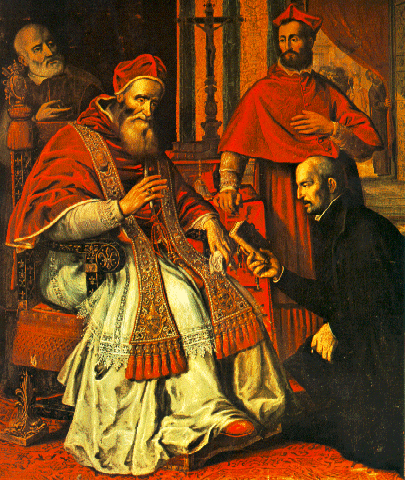
           More than a thousand years later St. Ignatius of Loyola is even more explicit in the Spiritual Exercises when he lists the rules “to have the true sentiment which we ought to have in the Church Militant”:  


Pope Paul III and St. Ignatius Loyola


To be right in everything, we ought always to hold that the white which I see, is black, if the Hierarchical Church so decides it, believing that between Christ our Lord, the Bridegroom, and the Church, His Bride, there is the same Spirit see which governs and directs us for the salvation of our souls. Because by the same Spirit and our Lord Who gave the ten Commandments, our holy Mother the Church is directed and governed.
                          
    St. Ignatius is not urging that Catholics leave their brain behind when they enter the Church: notice that he does not refer simply to white, but "the white which I see".  In other words, when it comes to fundamental categories (i.e., right and wrong), we need to trust the Church's judgment over our own, because she has been promised the guidance of the Holy Spirit, while we, as individuals, have not.


Every Man A Pope

    It really could not be any other way.  If we make ourselves the ultimate arbiters of truth instead of deferring to the Church, then the individual believer becomes, in effect, infallible, his or her own Pope, the result of which could only be thousands upon thousands of little schisms; any sort of real communion becomes impossible.  In fact, that is exactly what we see among our separated brethren in the Protestant communities, whose separate denominations are now said to number in the tens of thousands, less than five hundred years after Luther nailed his ninety-five theses to the church door in Wittenberg.
    In the end, faith itself becomes an impossibility, if there is no Truth greater than my own personal "truth".  And if I’m the supreme judge, why do I need a church to teach me anything? For that matter, what use is religion at all, or a Divine Savior, if it’s up to me to determine whether there’s any sin from which to save me? Isn’t that the logical end-point of the Hermeneutic of Suspicion?  Just myself, closed in upon myself. That’s an awfully cold, lonely way to spend eternity; it brings to mind what St. Paul says: “Wretched man that I am! Who will deliver me from this body of death?” (Romans 7:24).  Paul, of course, knows the answer: “Thanks be to God through Jesus Christ our Lord!” (Romans 7:25).  Only Christ can save me from myself, I myself who “do not do the good I want, but the evil I do not want” (Romans 7:19).  This same Christ has given His Church the power to bind and loose (Matthew 18:18); who am I, or any of us, to be its judge?

Wednesday, August 12, 2015

Is The Good The Enemy Of The Perfect?

An earlier version of this Worth Revisiting post was published under the title "The Forest and the Trees" on June 4th, 2014. To enjoy the work of other faithful Catholic bloggers see Worth Revisiting Wednesday, hosted by Elizabeth Reardon at theologyisaverb.com and Allison Gingras at reconciledtoyou.com.

     Like many of my fellow Catholics, I tend to focus on particular issues (for instance, life and family issues) as an expression of my faith and as a means of evangelizing.  But there is always the danger of losing sight of the Big Picture when we commit ourselves to specific causes which are necessarily finite and subordinate to Eternal Truths.  For example, one criticism of the “Abortion Myths” series that I have been posting is that we are in danger (or I am in danger) of reducing Catholicism to nothing more than an anti-abortion crusade.  One commenter suggested that we should instead simply preach the Gospel, and once we have converted the world the abortion problem will solve itself.


Leonard Porter, "Saint Paul Preaching on the Areopagus".

Admonish The Sinner

     There is a degree of truth in such criticism: there is always a possibility that we will be governed more by our own limited enthusiasms than by the will of God.  On the other hand, it is God’s will that we act against wrongs being committed in our own time and place.  This is stated over and over again in Holy Scripture, as in this Old Testament passage:

"So you, son of man, I have made a watchman for the house of Israel; whenever you hear a word from my mouth, you shall give them warning from me. If I say to the wicked, O wicked man, you shall surely die, and you do not speak to warn the wicked to turn from his way, that wicked man shall die in his iniquity, but his blood I will require at your hand.  But if you warn the wicked to turn from his way, and he does not turn from his way; he shall die in his iniquity, but you will have saved your life.  (Ezekial 33:7-9)

And here we see the same principle in the New Testament:

My brethren, if any one among you wanders from the truth and someone brings him back, let him know that whoever brings back a sinner from the error of his way will save his soul from death and will cover a multitude of sins. (James 5:19-20)

     Saint Peter gives us some guidance on how we can address particular situations without neglecting the Full Gospel:

But even if you do suffer for righteousness’ sake, you will be blessed.  Have no fear of them, nor be troubled, but in your hearts reverence Christ as Lord.  Always be prepared to make a defense to anyone who calls you to account for the hope that is in you, yet do it with gentleness and reverence; and keep your conscience clear, so that, when you are abused, those who revile your good behavior in Christ may be put to shame. (1 Peter 3:14-16)

By exemplifying in our manner and mode of address respect for the dignity of our adversary, we are preaching by example the Gospel of Christ’s love.


Practice What You Preach

     We very often see wonderful examples of this approach in some of the Church’s teaching documents, and in a special way in those addressing a particular wrong.  These magisterial correctives take advantage of the interest generated by a particular “hot topic” as a teachable moment both to gently yet firmly invite back those who have strayed, and also to give a positive lesson on how the Church’s teaching in a particular area is grounded in the greater principle of God’s all-embracing love.


Pope Paul VI and Cardinal Ratzinger
(now Bl. Paul VI and Pope Emeritus Benedict XVI)
     One such document is Pope Paul VI’s 1968 Encyclical Humanae Vitae [here], to which I will be returning in the near future.  Another less well-known one is the 1984 Congregation for the Doctrine of the Faith document called Instruction on Certain Aspects of the “Theology of Liberation” [here], signed by the CDF’s then prefect Joseph Cardinal Ratzinger.   The main purpose of the document is to correct errors in the Liberation Theology movement similar to those described above, specifically that it tends to give worldly “liberation” from material want and suffering precedence over the Liberation from Sin that is the true core of Christian belief, and also that it associates itself too closely with the anti-Christian political Philosophy of Marxism.  At the same time, the document acknowledges the areas where Liberation Theology is right, particularly its focus on very real problems of poverty, suffering and injustice in many parts of the world.  Finally, the document takes the opportunity to present a wonderfully concise mini-lesson in the Catholic understanding of poverty and our responsibility as Christians to work actively on behalf of the poor and oppressed.
     This document is but one of many examples of the fact that the Big Picture and finite issues are inextricably intertwined.  If our attempts to address and correct particular wrongs are not first grounded in Christ’s Love, then we are no better than “a noisy gong or clanging cymbal” (1 Corinthians 13:1), or worse than that if our lack of charity actually drives people away from the Gospel.  On the other hand, if we simply preach the Love of God without applying it to concrete situations, it becomes an insubstantial abstraction, and our Faith is as good as dead (see James, chapter 2).  Our role as Catholics is to be both/and, body and soul, and to witness to the Word made Flesh.  In no other way can we, as Saint Paul says (1 Timothy 6:12), “Fight the Good Fight”.


Wednesday, April 15, 2015

Is The Church a Political Animal? (from Nisi Dominus)

   You’re going to find politics wherever people gather, or so someone once told me when I had objected to using the secular political terms “liberal” and “conservative” to describe different factions within the Church.  And he was right, if by “politics” we mean the small-p wrangling that unavoidably accompanies any human enterprise requiring two or more people.  But that is a very different thing from Politics, of the partisan variety.  The Church is not a political party, and does not work like a political party.

The Synod on the Family, 2014


     That may seem an obvious point to you, but it’s not at all obvious to very many people.  It’s a distinction lost on most people outside of the Church for instance, for many of whom politics has taken the place of religion, and so has become the lens through which they interpret everything. Many such people have come to dominate the secular media in the developed world, with the result that the mass media projects the secular political model onto the Church, with “bad guys” called conservatives working to thwart the “good guys”, the liberals (sometimes referred to as progressives), who are fighting to bring about a kinder, better future.  This is the only image of the inner-workings of the Church most people see, including most ordinary Catholics . . .

(Please read the entire post HERE at Nisi Dominus)

Thursday, February 26, 2015

Can The Good Be The Enemy Of The Perfect?

     Like many of my fellow Catholics, I tend to focus on particular issues (for instance, life and family issues) as an expression of my faith and as a means of evangelizing.  But there is always the danger of losing sight of the Big Picture when we commit ourselves to specific causes which are necessarily finite and subordinate to Eternal Truths.  For example, one criticism of the “Abortion Myths” series that I have been posting is that we are in danger (or I am in danger) of reducing Catholicism to nothing more than an anti-abortion crusade.  One commenter suggested that we should instead simply preach the Gospel, and once we have converted the world the abortion problem will solve itself.


Leonard Porter, "Saint Paul Preaching on the Areopagus".

Admonish The Sinner

     There is a degree of truth in such criticism: there is always a possibility that we will be governed more by our own limited enthusiasms than by the will of God.  On the other hand, it is God’s will that we act against wrongs being committed in our own time and place.  This is stated over and over again in Holy Scripture, as in this Old Testament passage:

"So you, son of man, I have made a watchman for the house of Israel; whenever you hear a word from my mouth, you shall give them warning from me. If I say to the wicked, O wicked man, you shall surely die, and you do not speak to warn the wicked to turn from his way, that wicked man shall die in his iniquity, but his blood I will require at your hand.  But if you warn the wicked to turn from his way, and he does not turn from his way; he shall die in his iniquity, but you will have saved your life.  (Ezekial 33:7-9)

And here we see the same principle in the New Testament:

My brethren, if any one among you wanders from the truth and someone brings him back, let him know that whoever brings back a sinner from the error of his way will save his soul from death and will cover a multitude of sins. (James 5:19-20)

     Saint Peter gives us some guidance on how we can address particular situations without neglecting the Full Gospel:

But even if you do suffer for righteousness’ sake, you will be blessed.  Have no fear of them, nor be troubled, but in your hearts reverence Christ as Lord.  Always be prepared to make a defense to anyone who calls you to account for the hope that is in you, yet do it with gentleness and reverence; and keep your conscience clear, so that, when you are abused, those who revile your good behavior in Christ may be put to shame. (1 Peter 3:14-16)

By exemplifying in our manner and mode of address respect for the dignity of our adversary, we are preaching by example the Gospel of Christ’s love.


Practice What You Preach

     We very often see wonderful examples of this approach in some of the Church’s teaching documents, and in a special way in those addressing a particular wrong.  These magisterial correctives take advantage of the interest generated by a particular “hot topic” as a teachable moment both to gently yet firmly invite back those who have strayed, and also to give a positive lesson on how the Church’s teaching in a particular area is grounded in the greater principle of God’s all-embracing love.


Pope Paul VI and Cardinal Ratzinger
(now Bl. Paul VI and Pope Emeritus Benedict XVI)
     One such document is Pope Paul VI’s 1968 Encyclical Humanae Vitae [here], to which I will be returning in the near future.  Another less well-known one is the 1984 Congregation for the Doctrine of the Faith document called Instruction on Certain Aspects of the “Theology of Liberation” [here], signed by the CDF’s then prefect Joseph Cardinal Ratzinger.   The main purpose of the document is to correct errors in the Liberation Theology movement similar to those described above, specifically that it tends to give worldly “liberation” from material want and suffering precedence over the Liberation from Sin that is the true core of Christian belief, and also that it associates itself too closely with the anti-Christian political Philosophy of Marxism.  At the same time, the document acknowledges the areas where Liberation Theology is right, particularly its focus on very real problems of poverty, suffering and injustice in many parts of the world.  Finally, the document takes the opportunity to present a wonderfully concise mini-lesson in the Catholic understanding of poverty and our responsibility as Christians to work actively on behalf of the poor and oppressed.
     This document is but one of many examples of the fact that the Big Picture and finite issues are inextricably intertwined.  If our attempts to address and correct particular wrongs are not first grounded in Christ’s Love, then we are no better than “a noisy gong or clanging cymbal” (1 Corinthians 13:1), or worse than that if our lack of charity actually drives people away from the Gospel.  On the other hand, if we simply preach the Love of God without applying it to concrete situations, it becomes an insubstantial abstraction, and our Faith is as good as dead (see James, chapter 2).  Our role as Catholics is to be both/and, body and soul, and to witness to the Word made Flesh.  In no other way can we, as Saint Paul says (1 Timothy 6:12), “Fight the Good Fight”.

(An earlier version of this post was published under the title "The Forest and the Trees" on June 4th of last year)
    

Tuesday, February 10, 2015

Attende, Domine, et Miserere


Pope Benedict XVI blessing ashes on Ash Wednesday, February 17th, 2010, and the simple but lovely chant Attende Domini.  I have always admired how well the music fits the meaning in this hymn.  It is also a good way to start the penitential season that begins next week: "Heed me Lord, and have mercy, for we have sinned against you."


Attende Domine, et miserere, quia peccavimus tibi.


Saturday, January 17, 2015

Sunday Snippets - A Catholic Carnival & Hands Around the Capitol 2015

     Ah yes, another Sunday, another Sunday Snippets (A Catholic Carnival, don’t you know).  This is the first Sunday in a while that hasn’t been a solemnity of some sort, but that doesn’t mean that it’s just another Sunday: every Sunday is a commemoration of the Resurrection, a Little Easter . . . but I was talking about Sunday Snippets, wasn’t I?  It’s a weekly gathering of Catholic bloggers who gather here, at This That and the Other Thing (home of the esteemed RAnn) to share the fruits of their bloggery from the previous seven days.


Red roses representing years since Roe vs. Wade
     Before I get to my snippets from Principium et Finis, however, I’d like to share a little about where I was Saturday.  This coming Thursday will be the 42nd anniversary of the U.S. Supreme Court’s notorious Roe vs. Wade decision, which wiped out the abortion laws of all fifty states and created de facto abortion on demand in the United States; there have been an estimated 57 million legal abortions since that time.  Here in Maine we observe this sad anniversary with an event called  Hands Around the Capitol on the Saturday prior,  in which we hold a rally at the St. Michael’s (formerly St. Mary’s) gym, followed by a march to the State Capitol. Here, as participants hold hands in a ring around the entire building, one person rings a replica of the Liberty Bell on the Statehouse grounds once for every year since the Roe decision, while another places one rose beneath the bell at each tolling; this year 42 red roses lay in the snow at the end.
     A highlight of the rally this year was the return of pro-life governor Paul LePage.  When he spoke last year, he was a conservative, pro-family, anti-abortion governor seeking an unlikely re-election in a state dominated by the political left.  Seemingly oblivious to his tenuous political situation, he gave an impassioned speech denouncing abortion and praising the traditional family (see my account here).  He came back this year after winning more votes than any governor in Maine history, but he didn’t sound any different: abortion, LePage said, was robbing us of our future in a state where “more people are dying than are being born”, and the key to solving social problems like poverty is “getting the family unit back together”, to which the first step is “a man and a woman to take care of the children.”  Obvious, maybe blindingly obvious, but how many politicians have the political courage to come out and say it?
Governor LePage greeting rally participants
     Something new this year is that we have, in the words of Maine Right to Life Executive Director Theresa McCann Tumidajski, “the first United States Representative from Maine to call himself ‘proudly pro-life.’”  That would be Bruce Poliquin, newly elected congressman from the 2nd District.  Poliquin also gave a heartfelt defense of human life, even though he serves in a state where left-wing and pro-abortion groups have tremendous clout, and despite the fact that the Democratic leader in the U.S. House, California’s Nancy Pelosi, was hard at work trying to bring about his defeat in the next election even before he was sworn in (see here).
     Now, some will say that politicians will talk, but that it really doesn’t make any difference in the end.  When it comes to the right to life, pro-life laws and government officials do, in fact, make a difference, as I will show later this week in "Abortion Myth #17".  Also, the fact that these two men have been elected at all (in addition to a growing number of like-minded state senators and representatives) shows that there is hope for life.

   More photos from Hands Around the Capitol are posted below; meanwhile, here are snippets from the past week at Principium et Finis:

Monday – In the opera Don Giovanni, Mozart’s Don Juan enjoys some music from a couple of the composer’s contemporaries before he is dragged off to take up a well-deserved residence in Hell; one of those other composers, Giuseppe Sarti, had just arrived in Russia where he composed some beautiful music that looked to a much better place: “Giuseppe Sarti – ‘Now The Powers of Heaven’ & Russian Icon Painters” [here]

Tuesday – Planned Parenthood tells us that they mostly provide vital “health care” to women, such as mammograms, and abortion is just an afterthought - and if you believe that one . . . “Abortion Myth #16” [here] 

Wednesday –  Interesting news on the marriage front “Marriages Are Made in Heaven” [here] 

Thursday – This Ratzinger fellow sounds familiar . . . has he done anything since?  “Fr. Ratzinger’s Prophecy, 45 Years Later” [here] 

Friday – A picture’s worth a thousand words – and worth a human life: “The Truth Will Out” [here] 

Saturday - Hands Around the Capitol:


Brothers Jamie & Jared McCabe present a "Chalk Talk" at the rally


Governor LePage and young pro-life constituents in St. Michael's gym.


Pro-life Mainers gather at state capitol building


"Hands Around the Capitol"


Knights of Columbus with Blaine House (governor's mansion) in the background